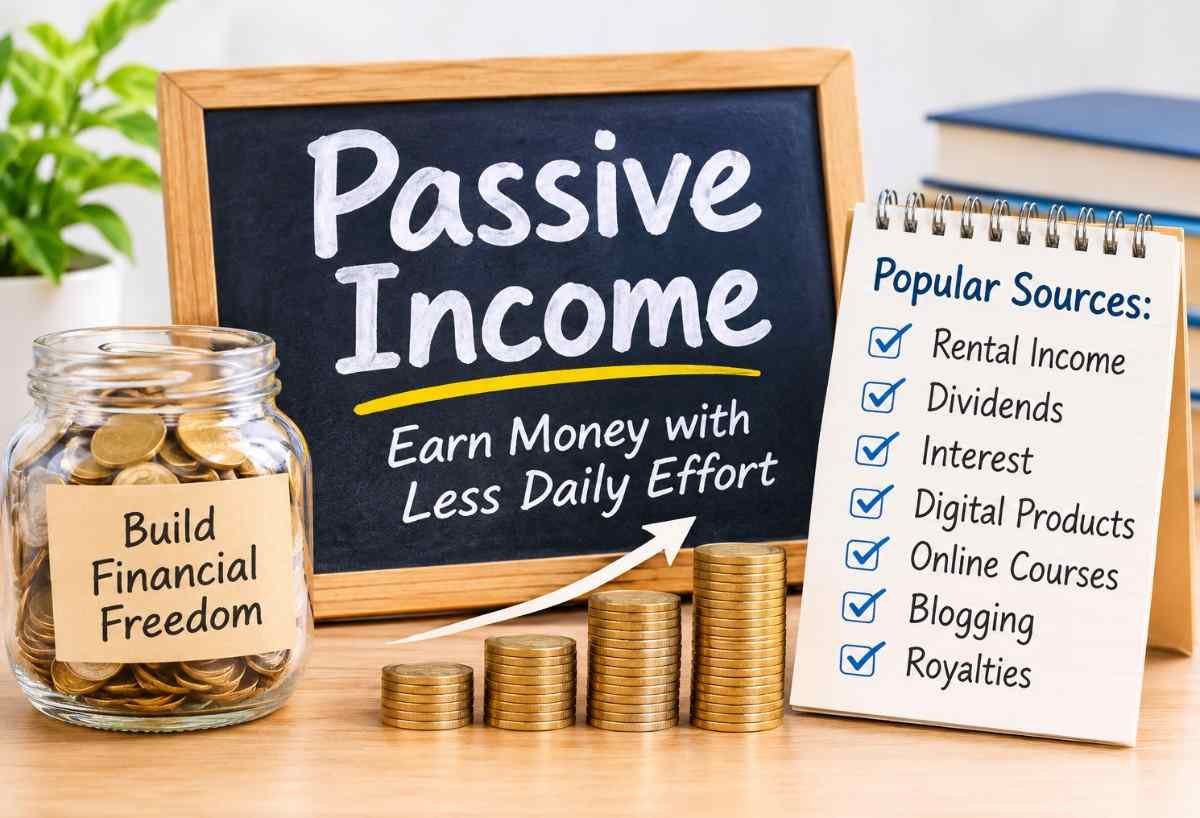
Passive income is a way of earning money that does not require constant, active involvement in daily work. It allows people to build additional income sources through investments, digital products, rental properties, royalties, and other income-generating activities.
In today’s world, many people are interested in learning about passive income because relying on a single source of income may not always provide financial flexibility. Students, working professionals, entrepreneurs, and retirees can all benefit from understanding how passive income works.
However, passive income does not mean earning money without doing anything. Most passive income sources require an initial investment of money, time, knowledge, or effort. Some also need regular maintenance and management.
This guide explains the meaning of passive income, its different types, real-life examples, benefits, limitations, and practical ways to understand how it works.
What Is Passive Income?
Passive income is money earned from an activity, investment, or asset that generally requires limited ongoing effort after the initial work or investment has been completed.
Unlike active income, where a person earns money by directly working for it, passive income can continue generating earnings even when the person is not actively involved every day.
For example, a person who owns a rental property may receive monthly rental payments from tenants. Similarly, someone who creates an educational e-book can continue earning money whenever customers purchase it.
Simple Definition: Passive income is money earned from assets or activities that do not require continuous active work to generate revenue.
How Does Passive Income Work?
Passive income generally works by creating or acquiring something that can generate money over time.
The process usually involves three main stages:
- Initial Investment or Effort: A person invests money, time, skills, or resources to create an income-generating asset.
- Income Generation: The asset or activity begins producing revenue through sales, rent, interest, royalties, or other payments.
- Ongoing Management: The person monitors and maintains the income source to keep it functioning properly.
For example, a person may spend several months creating an online educational course. Once published on a learning platform, students can purchase the course without the creator having to teach every lesson individually.
However, the creator may still need to update the course, answer questions, and promote it.
Passive Income vs. Active Income
Understanding the difference between passive and active income makes it easier to understand how people earn money.
| Basis | Passive Income | Active Income |
|---|---|---|
| Meaning | Income generated with limited ongoing involvement | Income earned through direct work |
| Time requirement | Usually less ongoing time after setup | Regular time and effort required |
| Examples | Rental income, royalties, dividends | Salary, hourly wages, freelancing |
| Work involvement | Initial work and occasional management | Continuous involvement |
| Earning potential | May continue over time | Often depends on working hours |
| Maintenance | May require periodic attention | Requires regular work performance |
Example: A teacher earns active income by teaching students in a classroom. If the teacher creates and sells a recorded educational course, the course may generate passive income from future purchases.
15 Types of Passive Income
Passive income can come from different sources. Some require financial investment, while others require creativity, technical knowledge, or initial hard work.
1. Rental Property Income
Rental property income comes from allowing other people to use a property in exchange for regular payments. Examples include renting apartments, houses, commercial buildings, or vacation properties.
Property owners can earn monthly income from tenants, although they must account for repairs, property taxes, insurance, vacancies, and management costs.
2. Dividend Income
Dividend income is money that some companies distribute to their shareholders from their earnings or reserves.
For example, an investor who owns shares in a dividend-paying company may receive dividend payments quarterly or at other scheduled intervals. However, companies are not guaranteed to pay dividends, and stock prices can fall.
3. Interest Income
Interest income is money earned by depositing or lending money at an agreed interest rate.
Common examples include:
- Savings accounts
- Certificates of deposit (CDs)
- Certain bonds
- Interest-bearing deposit accounts
The amount earned depends on the interest rate, deposit amount, and investment period.
4. Digital Product Sales
Digital products are items that customers can purchase and download or access online. They do not require physical manufacturing or shipping.
Examples include:
- E-books
- Printable planners
- Educational worksheets
- Digital templates
- Study guides
- Online resources
A creator can develop a digital product once and sell multiple copies, although marketing, customer support, and updates may require ongoing work.
5. Online Course Income
Online courses allow people to earn money by sharing their knowledge and teaching particular subjects.
For example, a professional can create a recorded course about graphic design, computer skills, language learning, or personal development.
Students can purchase and access the lessons online without requiring the instructor to teach every session live.
6. Book and E-book Royalties
Authors can earn royalties when their published books or e-books are sold. The payment usually depends on the publishing agreement, sales volume, and royalty rate.
For example, someone who writes a cooking guide or educational book may continue receiving payments from future purchases.
7. Stock Photography Income
Photographers can upload original photographs to stock photography websites and license them to customers.
Businesses, publishers, bloggers, and designers may purchase licenses to use these images.
A photograph can generate multiple licensing payments over time, depending on demand and the licensing arrangement.
8. Affiliate Marketing Income
Affiliate marketing involves promoting another company’s products or services through special tracking links.
When someone purchases through an eligible affiliate link, the promoter may receive a commission.
For example, an educational blogger may recommend books, learning tools, or software and earn a commission from qualifying purchases.
However, affiliate income depends on website traffic, audience trust, product relevance, and the affiliate program’s conditions.
9. YouTube Video Revenue
YouTube creators may earn money through eligible advertising, memberships, and other monetization features.
For example, someone who publishes educational videos about science, history, technology, or mathematics may continue receiving views on older videos.
However, earnings are not guaranteed, and creators need to follow platform monetization policies and regularly maintain their content.
10. Blogging Income
A blog can generate income through advertisements, affiliate links, sponsored content, and digital product sales.
For example, an educational website publishing articles about science, technology, history, and personal finance may earn advertising revenue when readers visit its pages.
Blogging usually requires considerable initial work, including research, writing, search engine optimization, and content updates. Income can also change with website traffic and advertising demand.
11. Real Estate Investment Trusts (REITs)
Real Estate Investment Trusts, commonly called REITs, allow individuals to invest in companies that own or finance income-producing real estate.
Some REITs distribute income to shareholders through dividends.
This can provide exposure to real estate without directly purchasing and managing a property. However, REIT prices and distributions can fluctuate, and investors can lose money.
12. Bond Income
Bonds are debt instruments through which investors lend money to governments, municipalities, or companies.
Depending on the bond’s terms, investors may receive interest payments during the investment period and repayment of principal at maturity.
Bond income can be relatively predictable for certain bonds, but risks include default, interest-rate changes, and inflation.
13. Licensing Income
Licensing income is earned when someone allows another person or organization to use their intellectual property in exchange for payment.
Examples include:
- Artwork
- Music compositions
- Software
- Designs
- Patented inventions
- Educational materials
The original creator may receive licensing fees or royalties according to the agreement.
14. Renting Out Equipment
People can earn additional income by renting equipment they already own.
Examples include cameras, photography equipment, power tools, gardening equipment, and specialized machinery.
This approach can help generate revenue from underused assets. However, equipment maintenance, insurance, damage, and rental coordination must be considered.
15. Automated Online Businesses
Some online businesses use technology and automated systems to handle parts of their operations.
Examples include digital subscription services, downloadable product stores, and software-as-a-service businesses.
Although certain processes can be automated, business owners may still need to handle customer service, technical problems, marketing, security, and product improvements.
Benefits of Passive Income
Passive income can offer several advantages when developed carefully. It may help individuals improve their financial flexibility and create additional earning opportunities.
- Additional Income Source: Passive income can provide money alongside a regular salary, business income, or other earnings.
- Financial Flexibility: Extra earnings may help people manage everyday expenses, save money, or work toward financial goals.
- Long-Term Wealth Building: Certain investments and income-generating assets may increase in value or produce earnings over time.
- Less Dependence on One Income Source: Having multiple income sources can reduce reliance on a single employer or business.
- Time Flexibility: Some passive income activities require less daily involvement once they are properly established.
- Opportunity for Financial Education: Building passive income can encourage people to learn about investing, budgeting, business management, and financial planning.
- Potential for Recurring Earnings: Rental payments, subscription revenue, interest, and certain royalties may provide repeated payments.
- Better Use of Existing Skills: People can turn their knowledge, creativity, or professional experience into educational products and other income-generating assets.
- Possible Income During Retirement: Certain investments and assets may provide additional retirement income, depending on their performance and structure.
- Scalable Opportunities: Some digital products and online resources can reach more customers without requiring the same increase in production effort.
Disadvantages or Risks of Passive Income
Although passive income has advantages, it also comes with limitations and financial risks. Understanding these challenges is important before choosing an income source.
- Initial Investment Required: Some passive income opportunities require significant money, time, knowledge, or resources before generating earnings.
- No Guaranteed Earnings: Investments, digital products, websites, and rental properties may not produce consistent income.
- Maintenance and Management: Many income sources require occasional repairs, updates, monitoring, customer service, or administration.
- Financial Risk: Investments and business activities can lose money due to market conditions, competition, or unexpected expenses.
- Slow Results: Building a reliable income source may take months or years.
- Tax Responsibilities: Income from investments, rental properties, royalties, and other activities may create tax obligations.
- Changing Market Demand: A product, website, or service that generates income today may become less popular in the future.
- Platform Dependence: Online creators and sellers may be affected by changes in advertising policies, algorithms, fees, or platform rules.
- Competition: Popular income-generating activities can attract many competitors, making it harder to earn money.
- Not Completely Hands-Off: The idea of earning money without any future involvement is often unrealistic.
Passive Income Ideas for Students
Students can learn about passive income by exploring opportunities that use their existing knowledge, interests, and creative skills.
Some educationally useful examples include:
- Creating and selling study notes or revision guides.
- Publishing educational e-books.
- Designing printable planners and study schedules.
- Creating recorded lessons for subjects they understand well.
- Selling original digital templates.
- Starting an educational blog.
- Publishing educational videos.
- Creating original stock photographs or illustrations.
Students should prioritize their education and avoid opportunities that require large upfront payments or promise guaranteed earnings.
How to Start Building Passive Income
Building passive income is generally a gradual process. It is better to understand an opportunity before investing money or spending considerable time on it.
1. Understand Your Skills and Resources
Start by identifying what you already have. This may include professional knowledge, writing skills, savings, creative abilities, technical experience, or useful assets.
2. Choose an Income Source
Select an opportunity that matches your financial situation, interests, available time, and level of knowledge.
For example, someone with writing skills may explore e-books or blogging, while someone with investment knowledge may study dividend-paying investments.
3. Research the Opportunity
Learn how the income source works, what it costs, how payments are generated, and what risks are involved.
Do not rely only on social media success stories or promotional claims.
4. Calculate Initial and Ongoing Costs
Consider the expenses associated with creating, purchasing, or maintaining an income-generating asset.
For example, rental properties may involve maintenance and insurance, while digital products may require software, marketing, and platform fees.
5. Start With a Realistic Goal
Set a manageable goal rather than expecting immediate financial independence.
Your first objective might be to create one digital product, understand how dividend payments work, or learn how to publish an educational website.
6. Monitor Your Progress
Track the money invested, income received, expenses, and time required.
This helps you understand whether an income source is genuinely profitable.
7. Improve and Maintain Your Income Source
Update products, maintain assets, review investment performance, and improve your systems when necessary.
Passive income generally becomes more sustainable when the underlying asset or activity is managed responsibly.
Active Income and Passive Income Examples in Real Life
The following examples show how the same skill or asset can generate either active or passive income, depending on how it is used.
| Situation | Active Income | Passive Income |
|---|---|---|
| Teaching | Teaching live classes | Selling recorded courses |
| Writing | Writing articles for clients | Earning book royalties |
| Photography | Taking paid photoshoots | Licensing existing photographs |
| Real Estate | Working as a property agent | Receiving rental income |
| Investing | Working as a financial analyst | Receiving eligible dividends |
| Blogging | Writing articles for clients | Earning revenue from published content |
These examples demonstrate that passive income is often created by turning existing work, knowledge, or assets into something that can generate repeated earnings.
Is Passive Income Really Passive?
Passive income is not always completely passive. The term describes income that generally requires less continuous involvement than traditional employment.
For example, a rental property may generate monthly rent, but the owner still needs to manage maintenance, insurance, tenants, and other responsibilities.
Similarly, a blog may continue earning advertising revenue from older articles, but its owner may need to update content, maintain the website, and attract visitors.
It is important to distinguish between earning money with limited ongoing effort and earning money without any effort. These are not the same.
Is Passive Income Taxable?
Yes, many forms of passive income can be taxable. However, the tax treatment depends on the type of income, the country, and applicable tax laws.
For example, in the United States:
- Interest Income: Interest earned from certain savings accounts and investments is generally taxable.
- Dividend Income: Dividends may be subject to federal income taxes, with different rules for qualified and ordinary dividends.
- Rental Income: Rental earnings may need to be reported, with certain eligible expenses potentially deductible.
- Royalty Income: Royalties from intellectual property may have specific reporting and tax requirements.
- Investment Income: Capital gains and other investment earnings may be subject to applicable tax rules.
The IRS distinguishes between passive activities and portfolio income. Its technical definition of passive activity does not include all income commonly described as passive in everyday financial discussions. (Internal Revenue Service)
People earning income in the United States should consult the IRS guidelines or a qualified tax professional to understand their reporting responsibilities.
Common Myths About Passive Income
Several misconceptions can create unrealistic expectations about passive income. Understanding the facts helps people make better financial decisions.
- Myth 1: Passive Income Means Free Money. Fact: Most opportunities require an initial investment of time, money, skills, or resources.
- Myth 2: Passive Income Makes People Rich Quickly. Fact: Building sustainable income often requires patience, planning, and consistent effort.
- Myth 3: Passive Income Never Requires Work. Fact: Many income sources need regular monitoring, maintenance, and improvements.
- Myth 4: Anyone Can Earn the Same Amount. Fact: Earnings depend on experience, investment, market demand, competition, and other factors.
- Myth 5: Passive Income Has No Financial Risk. Fact: Investments and business activities can lose money.
- Myth 6: You Need a Lot of Money to Start. Fact: Some opportunities, such as creating educational digital products, can begin with relatively limited financial resources, although they still require effort.
Passive Income and Financial Independence
Financial independence means having sufficient financial resources or income to support your living expenses without depending entirely on traditional employment.
Passive income may contribute to this goal by creating additional sources of earnings.
For example, imagine someone who earns a salary and gradually develops three additional income sources:
- Interest from savings.
- Income from a digital educational product.
- Dividends from eligible investments.
Over time, these sources may help increase financial flexibility. However, their earnings can fluctuate, and they may not always cover living expenses.
Financial independence generally requires a combination of budgeting, saving, investing, managing debt, and making informed financial decisions.
Important Factors to Consider Before Choosing Passive Income
Before starting any passive income activity, consider the following factors:
- Risk Level: Understand how much money you could potentially lose.
- Initial Investment: Calculate how much money or time is required to get started.
- Income Potential: Research realistic earning possibilities instead of relying on guaranteed-income claims.
- Time Commitment: Determine how much ongoing attention the opportunity requires.
- Market Demand: Check whether people actually need or want the product, service, or asset.
- Legal Requirements: Understand relevant business, licensing, property, and tax rules.
- Long-Term Sustainability: Consider whether the income source can remain useful and competitive over time.
A good passive income opportunity should fit your circumstances rather than simply follow a popular online trend.
Conclusion
Passive income is an important financial concept that explains how people can generate money from investments, assets, creative work, and business activities without depending entirely on continuous daily labor.
Common examples include rental income, dividends, interest, digital products, online courses, book royalties, and blogging revenue.
Although passive income can offer additional earning opportunities, it is not guaranteed or completely effortless. Most income sources require initial planning, financial resources, ongoing management, and an understanding of potential risks.
FAQ’s
Can students earn passive income?
Yes. Students can earn passive income by creating e-books, selling digital study materials, publishing online courses, or starting educational blogs.
What is the easiest passive income to start?
Creating digital products, publishing e-books, and selling educational resources can be accessible starting points for people with useful skills or knowledge.
Can passive income make you rich?
Passive income can contribute to long-term wealth building, but financial success depends on investment decisions, expenses, market conditions, and consistency.
Can passive income replace a full-time job?
Yes, it may be possible if passive income becomes sufficient and sustainable to cover living expenses, but earnings are not guaranteed.
Do you need money to earn passive income?
No. Some opportunities require more time and skills than money, such as creating digital products, educational content, or e-books.
Why is passive income important?
Passive income can provide additional earnings, improve financial flexibility, reduce dependence on a single income source, and support long-term financial goals.
Is passive income better than active income?
Neither is universally better. Active income provides earnings through direct work, while passive income can provide additional earnings from assets or activities requiring less continuous involvement. Both can play useful roles in financial planning.
Can passive income be earned online?
Yes. Online courses, e-books, blogging, affiliate marketing, digital downloads, and licensing creative work are examples of online income opportunities that may become partially passive.
Is rental income considered passive income?
Rental income is commonly described as passive income because property owners receive payments for allowing tenants to use their property. However, property management and tax treatment can vary.
Sources / References:
- U.S. Bank – Passive Income Ideas and Financial Education
- Internal Revenue Service – Investment Income and Expenses
- Internal Revenue Service – Passive Activity and At-Risk Rules
- Internal Revenue Service – Taxable Income
- Investor.gov – Passive Income Glossary
Disclaimer:
This article is intended for educational and informational purposes only. It does not constitute financial, investment, or tax advice. Consult a qualified financial or tax professional before making financial decisions.
Also Read: