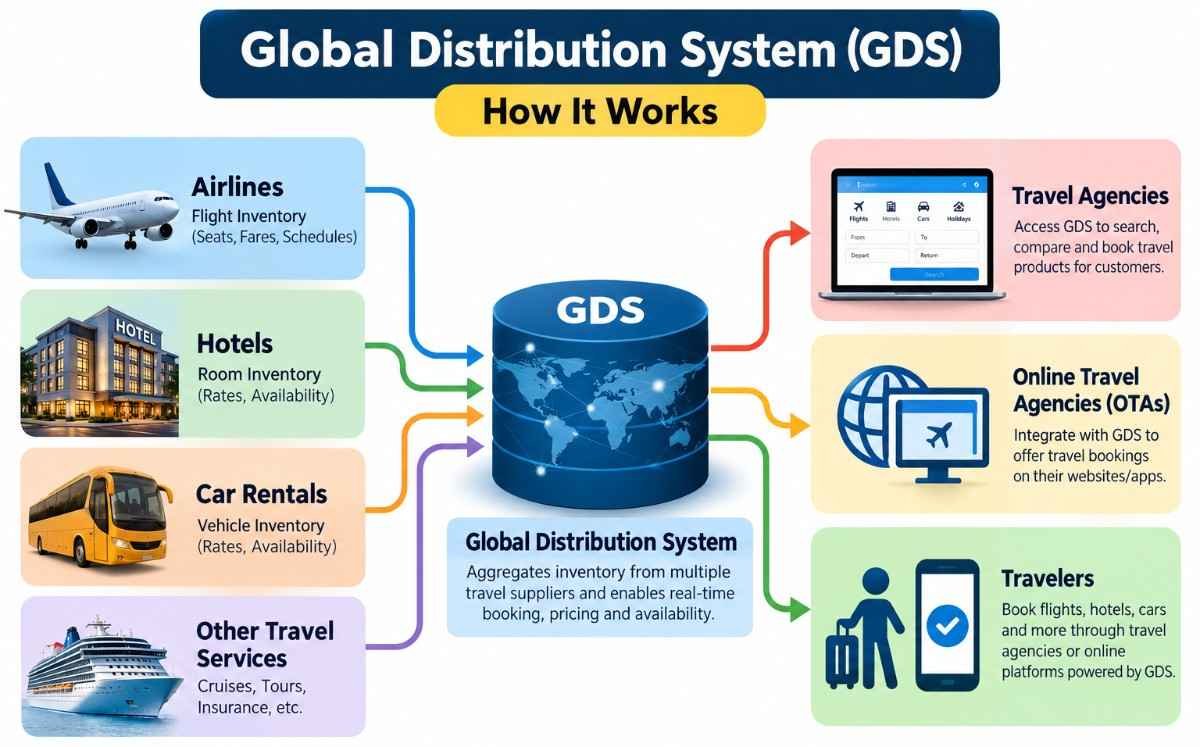
The travel and tourism industry depends on technology to connect airlines, hotels, travel agencies, car rental companies, and travelers around the world. One important technology that makes these connections possible is the Global Distribution System (GDS).
A Global Distribution System helps travel professionals search for travel options, compare prices, check availability, and make reservations through a centralized platform. Instead of visiting the websites of multiple airlines and hotels separately, a travel agent can use a GDS to access information from many participating travel providers in one place.
For students studying travel and tourism, hospitality, aviation, or travel agency management, understanding GDS is an important part of learning how modern travel bookings work.
What Is a Global Distribution System (GDS)?
A Global Distribution System (GDS) is a computerized travel distribution network that connects travel service providers with travel agencies and other travel sellers. It allows users to access travel information and make reservations through a single system.
A GDS can provide information about:
- Airline schedules, fares, and seat availability.
- Hotel room availability, rates, and booking conditions.
- Car rental options and prices.
- Rail travel and other travel-related services, depending on the system and its connections.
The system acts as a technology intermediary between travel suppliers and sellers. It generally does not own the airline seats or hotel rooms it distributes; the inventory belongs to the relevant travel provider.
Simple example: Imagine a customer wants to travel from Mumbai to London and needs a hotel in London. A travel agent can use a GDS to compare available flights from participating airlines, review suitable hotel options, and create reservations without working separately with every provider.
Full Form of GDS
GDS stands for Global Distribution System.
- Global: It connects travel businesses and sellers across different markets and countries.
- Distribution: It helps make travel products available through different sales channels.
- System: It uses computer technology and connected databases to support searching, booking, and reservation management.
How Does a Global Distribution System Work?
A GDS works by exchanging information between travel service providers and travel sellers. The process usually follows these steps.
Step 1: Search for travel services:
The travel agent enters details such as the destination, travel dates, number of passengers, or hotel requirements.
Step 2: Retrieve available information:
The GDS communicates with connected supplier systems to retrieve available schedules, prices, rooms, seats, and relevant booking conditions.
Step 3: Compare the options:
The agent reviews the available choices and selects options that suit the customer’s budget, schedule, and preferences.
Step 4: Make the reservation:
The agent submits the booking request, and the relevant supplier system confirms the reservation if the requested inventory remains available.
Step 5: Manage the booking:
Depending on the booking and system permissions, the agent may be able to issue tickets, retrieve booking details, change travel arrangements, or process cancellations.
This process allows travel professionals to manage many booking tasks more efficiently. However, the exact features depend on the GDS, supplier agreements, and the type of reservation.
Major Global Distribution System Providers
Several companies provide GDS technology for the global travel industry. Three widely recognized providers are Amadeus, Sabre, and Travelport.
1. Amadeus:
Amadeus provides travel technology used by airlines, travel agencies, hotels, and other travel businesses. Its platform supports travel distribution, reservations, and related services.
Official website: Amadeus
2. Sabre:
Sabre supplies technology for travel agencies, airlines, and other travel businesses. Its systems support travel shopping, reservations, and travel management operations.
Official website: Sabre
3. Travelport:
Travelport provides travel distribution technology that enables travel agencies to search and book services from multiple travel suppliers. Its portfolio includes Travelport+ and systems associated with Galileo, Apollo, and Worldspan.
Official website: Travelport
These providers offer different products, interfaces, integrations, and market capabilities. The best system for a travel agency depends on its business needs, location, supplier access, and booking volume.
Main Functions of a Global Distribution System
A GDS performs several important functions in travel agency and tourism operations.
- Flight Reservation: Allows travel agents to search flight schedules, compare fares, check availability, and reserve seats on participating airlines.
- Hotel Booking: Provides access to participating hotels, room types, rates, availability, and booking conditions.
- Car Rental Reservation: Helps agents search for rental vehicles and make reservations with connected providers.
- Fare Comparison: Displays available fares and relevant conditions to help agents compare travel options.
- Ticket Issuance: Supports airline ticketing through authorized workflows and applicable airline arrangements.
- Passenger Name Record Management: Helps create and retrieve booking records containing itinerary and passenger-related information.
- Reservation Modification: Supports eligible booking changes, subject to supplier rules and system permissions.
- Cancellation and Refund Support: Provides tools for handling eligible cancellations, exchanges, and refunds.
- Travel Itinerary Creation: Helps organize flight segments and other booked travel services into a travel plan.
- Booking Information Management: Makes reservation details accessible for servicing and operational purposes.
Not every GDS supports every function in the same way, and some services may require additional software or supplier connections.
Types of Services Available Through a GDS
The services accessible through a GDS depend on the provider and its participating suppliers.
| Travel service | Information or booking support |
|---|---|
| Airlines | Flight schedules, fares, seats, and reservations |
| Hotels | Room availability, rates, and reservations |
| Car rentals | Vehicle options, prices, and bookings |
| Rail services | Train schedules and ticket options where supported |
| Cruises | Cruise availability and reservations where supported |
| Additional travel services | Selected ancillary services and travel products |
A GDS may also connect with other distribution channels and booking technologies to provide a wider range of travel content.
Importance of GDS in the Travel and Tourism Industry
Global Distribution Systems play an important role in connecting travel suppliers with travel sellers. Their importance goes beyond making reservations.
- Wider Market Reach: Travel providers can distribute their products to travel agencies and other sellers in different markets.
- Centralized Access: Agents can search multiple suppliers through a connected platform instead of relying entirely on separate systems.
- Faster Booking Processes: Automated information exchange can reduce repetitive manual work.
- Improved Customer Service: Agents can compare travel options and help customers choose suitable arrangements.
- Business Travel Support: Corporate travel teams can use GDS-connected tools to manage employee itineraries and reservations.
- Booking Administration: Reservation records can support itinerary management, ticketing workflows, and customer service.
- International Connectivity: Participating suppliers and sellers can conduct travel transactions across different countries and markets.
These benefits depend on the supplier coverage, system capabilities, and commercial arrangements available to each business.
Advantages of a Global Distribution System
A GDS offers several practical advantages for travel agencies, suppliers, and customers.
Advantages for Travel Agents
- Time Savings: Agents can search and compare multiple travel options through a single interface.
- Access to Multiple Suppliers: A connected system can provide access to participating airlines, hotels, and other travel providers.
- Convenient Reservation Management: Agents can use available tools to retrieve and service bookings.
- Better Travel Planning: Comparing schedules, prices, and conditions helps agents prepare suitable itineraries.
- Improved Productivity: Automated workflows can reduce repetitive administrative tasks.
Advantages for Travel Suppliers
- Expanded Distribution: Airlines and hotels can reach travel sellers beyond their direct sales channels.
- Additional Sales Opportunities: Access to agency networks may help suppliers attract new customers.
- Standardized Connectivity: Established distribution technology can reduce the need for separate connections to every travel seller.
- Business Visibility: Participating suppliers can make their available travel products accessible through connected sales channels.
Advantages for Customers
- More Choices: Customers may receive several flight, hotel, or rental options to compare.
- Convenient Booking Assistance: Travel agents can organize reservations using connected systems.
- Itinerary Coordination: Agents can help combine different travel services into one travel plan.
- Professional Support: Customers can receive assistance with eligible booking changes and other travel arrangements.
Disadvantages and Limitations of GDS
Although GDS technology is useful, it also has limitations that students and travel professionals should understand.
- Training Requirements: New users may need specialized training to use the system accurately.
- Operating Costs: Access, technology integration, training, and transaction-related fees can increase business expenses.
- Technical Problems: System outages or connectivity issues can interrupt booking activities.
- Supplier Coverage Limitations: Not every airline, hotel, fare, or service is necessarily available through every GDS.
- Complex Booking Rules: Fare conditions, ticketing requirements, and exchange policies may require careful interpretation.
- Integration Challenges: Agencies may need to connect the GDS with accounting, customer management, or other booking software.
- Changing Travel Technology: Agents must continue learning as booking systems and distribution methods evolve.
A GDS is therefore a powerful business tool, but it does not eliminate the need for trained staff, accurate information, and good customer service.
Difference Between GDS, CRS, and OTA
These three terms are closely related, but they describe different parts of the travel booking process.
| Feature | GDS | CRS | OTA |
|---|---|---|---|
| Full form | Global Distribution System | Central Reservation System | Online Travel Agency |
| Main purpose | Distributes travel products from multiple suppliers | Manages reservations and inventory for a supplier or organization | Sells travel services to customers online |
| Typical users | Travel agencies and travel management companies | Airlines, hotel groups, and other suppliers | Travelers and online shoppers |
| Main role | Connects travel sellers with suppliers | Maintains supplier booking information | Provides a customer-facing booking channel |
| Example | Amadeus, Sabre, Travelport | An airline’s or hotel group’s reservation system | An online travel booking website |
A GDS distributes travel content, a CRS manages reservation and inventory information for a supplier, and an OTA sells travel services through an online customer-facing platform. These systems can work together, and an OTA may obtain travel content through a GDS, direct supplier connections, or other distribution channels.
Practical Example of a GDS in Travel Agency Operations
Consider a customer who wants to travel from Delhi to Singapore for a business meeting.
The customer contacts a travel agency and requests a suitable flight, a hotel near the meeting venue, and a rental car.
Here is how the travel agent may use a GDS:
- The agent enters the customer’s preferred travel dates and destination.
- The system displays available flight options and applicable fares from connected suppliers.
- The agent compares departure times, journey duration, prices, and fare conditions.
- The agent searches for participating hotels and checks room rates and availability.
- The agent reviews available rental car options, if supported.
- After confirming the customer’s choices, the agent submits the relevant booking requests.
- The agent provides the confirmed itinerary and applicable booking details to the customer.
If the customer later needs to change the return flight, the agent checks the ticket conditions and available servicing options before making an eligible change.
This example shows how a GDS can help coordinate multiple travel services through connected technology rather than requiring the agent to manage every supplier relationship separately.
Skills Required to Work with a GDS
Students who want to work in travel agencies, aviation, hospitality, or corporate travel management can benefit from learning GDS operations.
Important skills include:
- Computer Skills: Ability to work with booking software and digital reservation systems.
- Travel Geography: Knowledge of countries, cities, airports, and time zones.
- Airline Knowledge: Understanding of flight schedules, airport codes, fare classes, and ticketing basics.
- Reservation Management: Ability to create, retrieve, and review booking records accurately.
- Customer Service: Understanding customer requirements and explaining available options clearly.
- Attention to Detail: Checking passenger names, dates, routes, and fare conditions carefully.
- Problem-Solving: Handling booking errors, schedule changes, and customer requests.
- Communication Skills: Coordinating with customers, suppliers, and other travel professionals.
Formal training can help learners understand specific GDS interfaces and booking procedures. The skills required will vary according to the job role and the system used by the employer.
GDS in the Modern Travel Industry
Travel distribution continues to evolve. Traditional GDS platforms now operate alongside supplier websites, application programming interfaces (APIs), online travel agencies, and newer airline distribution standards.
One example is New Distribution Capability (NDC), an airline distribution standard developed by the International Air Transport Association (IATA). NDC supports the exchange of airline offers and related information through standardized data formats. It is not itself a GDS. Modern travel platforms may support both traditional GDS content and NDC-enabled offers.
This development means that travel professionals need to understand not only traditional reservation systems but also how different distribution channels work together.
Key Terms Students Should Know
| Term | Meaning |
|---|---|
| GDS | A Global Distribution System connecting travel suppliers and sellers |
| CRS | A Central Reservation System used to manage reservations and inventory |
| OTA | An Online Travel Agency that sells travel services through a website or app |
| PNR | Passenger Name Record; a record associated with a travel reservation |
| API | Application Programming Interface; a method for software systems to exchange information |
| Fare Rules | Conditions governing a ticket’s use, changes, cancellations, or refunds |
| Inventory | Travel products available for sale, such as airline seats or hotel rooms |
| NDC | New Distribution Capability, an airline distribution standard developed by IATA |
FAQ’s
What is a Global Distribution System in simple words?
A Global Distribution System is a computerized platform that helps travel agents search, compare, and book travel services from multiple connected suppliers.
What is the main purpose of a GDS?
The main purpose of a GDS is to connect travel suppliers with travel sellers and make travel information, availability, and booking services accessible through a centralized system.
Is a GDS used only for airline reservations?
No. Depending on supplier connections and system capabilities, a GDS can also support hotel bookings, car rentals, rail services, cruises, and other travel-related products.
What is the difference between GDS and CRS?
A GDS distributes travel products from multiple suppliers, while a CRS generally manages reservation and inventory information for an individual supplier or organization.
What is the difference between GDS and OTA?
A GDS is a travel distribution technology platform used by travel businesses, while an OTA is an online business that sells travel services to customers.
Do travel agents need GDS training?
GDS training can be valuable for travel agency and airline reservation jobs. It helps learners understand booking procedures, reservation records, fare rules, and ticketing workflows.
Does a GDS own airline seats or hotel rooms?
Generally, no. The airline, hotel, or other supplier controls its inventory. The GDS provides connectivity and distribution, while the supplier’s systems manage the relevant inventory and confirm reservations.
What is GDS in BPO?
GDS in BPO refers to using Global Distribution Systems to manage travel-related services, including flight reservations, ticketing, cancellations, and customer inquiries for travel companies.
What are GDS skills?
GDS skills include using reservation systems such as Amadeus, Sabre, or Travelport to check flight availability, book tickets, manage passenger records, understand fare rules, and handle booking changes.
Disclaimer:
This article is intended for educational purposes only. System features and booking procedures may vary by provider, supplier, and travel agency. Always consult official documentation for operational guidance.
Also Read: