Contents :
- Meaning & Definition of New Product Development.
- Need for New Product Development.
- Failure of New Product.
- Booz, Allen, and Hamilton Classification Scheme for New Products.
What is New Product Development ?
The goods and services that vary considerably in terms of their attributes or intended usage in contrast with the goods manufactured previously by the same firm are termed as “‘new products”. It is a difficult task to define a new product.
It involves novel ideas and offerings which are entirely different and new for the customers. Moreover, the relative view is considered highly useful in defining a new product, as the potential consumers who will be using the product for the first time, may identify opportunities or problems for consideration.
The concept of a new product is highly multi dimensional, which has capabilities of satisfying the wants of desirous and interested stockholders. It also provides strategic competitive advantage to significant number of interested consumers. This also leads to significant opportunity for a firm to create value in the competitive market. There are various perspectives from which a new product could be defined.
Definition of New Product Development
According to Musselman and Jackson :
“A product is said to be a new product when it serves an entirely new function or makes a major improvement in a present function.”
According to Kotler :
“New product mean original products, improved products, modified products and new brands which are developed by the firm through its own research and development efforts and includes those products which the consumers see as new. A new product is thus perceived differently by different people. It is a need satisfying concept with benefit for buyers bundle of need satisfying features, for marketers, a way to add value for intermediaries, an opportunity to design, for R&D and to assemble and process for production department.
After product planning, the next step is product development. The process of identifying the probability of producing a product is called product development. Under this process, the feasibility and profitability of producing a new product is assessed before making a final decision.
According to Limpson and Darling :
“Product development involves the adding, dropping, and modification of item specifications in the product line for a given period of time, usually one year”.
New product development involves all the phases and functions in launching a new product or service. The process starts with emergence of a new idea and ends with the commercialization of new product in the market. New product development encompasses competitive pressure, cost challenges and increased consumer expectations which helps the firm to develop an enhanced and better-quality product for the market. Through acquisition or development, a firm can introduce new products in the market. The
following are three forms of acquisition :
1) By buying other companies.2) By acquiring patents from other companies.3) By purchasing license or franchise from another company.
Need for New Product Development
The organizations which are aiming at advanced levels of growth have to consider the following points:
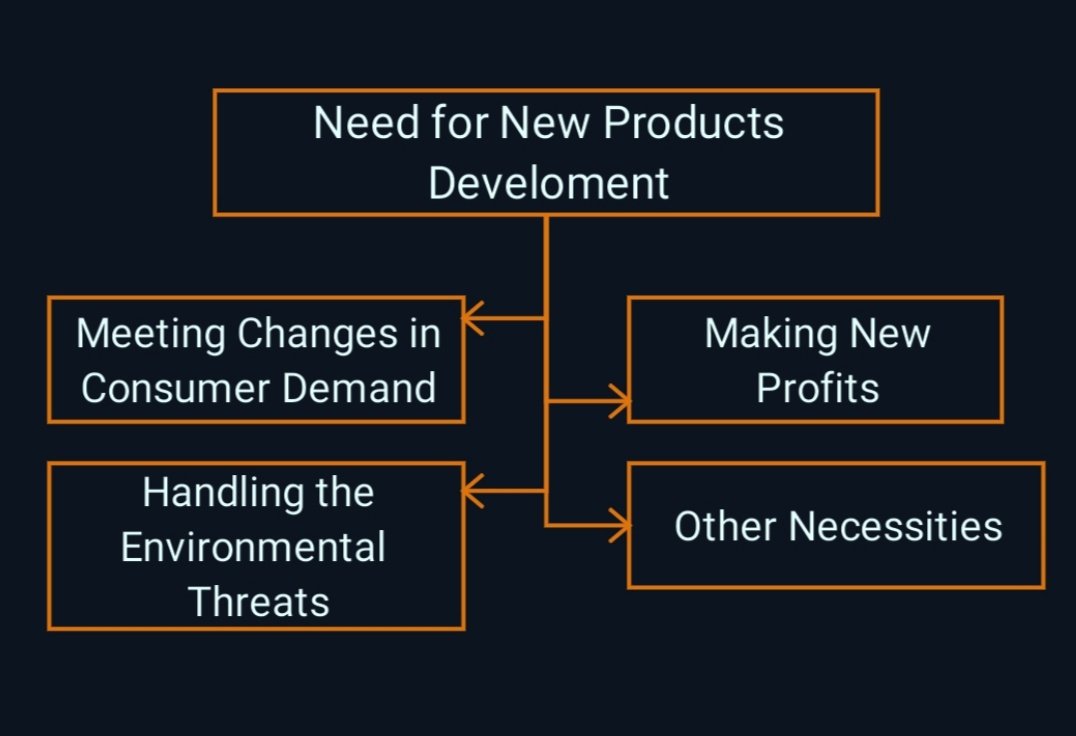
1) Meeting Changes in Consumer Demand :
Change is a universal phenomenon in today’s time of science and technology. For example, a quick change in the food habits, comfort preferences, tastes, customs and traditions, needs and expectations, etc. can be seen. The organizations need to keep an eye on these changes taking place in their surroundings.
Customers always give preference to the products which are better in terms of quality, fashion, price, etc. An organization has to proactively respond to such vibrant demands, which in turn results in innovations in products and services. By doing this, the organizations can keep themselves updated and can strengthen their relationship with the customers.
2) Making New Profits :
Manufacturing new products is important for earning profits; since existing products have less scope for enhancing profit levels, while new products have vast scope for it. On reaching the maturity stage of PLC, the gains acquired from the existing products start decreasing and diminishes gradually till the product reaches the decline stage. Hence, it becomes quite necessary for the organizations to come up with the new and innovative products that can replace the old product which is on the verge of declining. Such new products play an important role in growth of the organization and sometimes they are the only source for the organization to find new prospects of profit.
3) Handling the Environmental Threats :
There are various environmental threats faced by a business organization. One way to handle these threats is to find out a new product which is capable enough to combat against it. These threats spring from various environmental factors, like socio-economic, technological, political, and demand and supply, etc. Moreover, the biggest threat that is always present in such environment is competition in the market and products.
Hence, it becomes vital to fight these risk factors by introducing new products. More prospects of growth and development are opened through it, which further ensures endurance and feasibility for the organization.. I also distributes the risk factor among the old and new products.
4) Other Necessities :
The other strategic needs for new product development are as follows :
- New products can provide the organization a source for gaining competitive edge.
- They can ensure long-term financial return on the investments made. They also help in optimum utilization of the available resources.
- New products make best use of research and development.
- They can provide new opportunities for making changes in the strategic plans of the company.
- New products can bring most out of the marketing practices and brand equity.
- It enhances the corporate image of the organization/brand.