- Introduction and Definition of Business Research.
- Reasons for Studying Business Research.
- Role of Business Research.
- Research Applications in Functional Areas of Business.
- Emerging Trends in Business Research.
- IT Developments, Which has Affected the Techniques and Methods of Business Research.
- Business Research and other Information Sources.
WHAT IS BUSINESS RESEARCH ?
Business research is the systematic investigation and analysis of data and information to gain insights and make informed decisions to enhance business practices and strategies.
Research conducted or describing the business problem(s) of a particular business, is called Business research. For example, in order to start a particular business it is very crucial for the entrepreneur or the owner to have information about the type of customers and nature of competition in the market. It helps in designing business plan for the organisation. All these information can be availed only through the business research. It plays a key role in deriving consumer demand for the existing business, The scope of business research covers small topics (like finding an idea and a name for the business) as well es, big and thorough topics (like collecting information about consumer demand, buying trends, competitor analysis, etc.). In fact, the overall business research process is focused to help business through collecting important information from the market.
According to McDaniel and Gates :
“Business research is the planning, collection and analysis of data relevant to business decision-making and the communication of the results of this analysis to management”.
According to Zikmund :
“Business research is a management tool that companies use to reduce uncertainty. It is a manager’s source of information about organisational and environmental conditions and covers topics ranging from long range planning to the most ephemeral tactical decisions”.
Why Study Business Research ?
Reasons for Studying Business Research :
1) Estimating Expenses :
Business research is useful in estimating expenses for a business especially Dew one. Generally, the expenses of a new business overflow the estimated amount. Without having information about the true cost of production it is not possible for the owner or entrepreneur to decide the prices of organisational products and services. Therefore, business research is used by owners so as to deal with such problems. It includes collecting information about different aspects of production like business licences, raw materials, packaging. warehousing, etc.
2) Price Determination :
Another factor proving to the need of studying business research is price determination in organisation. Ineffective pricing strategies may lead the organisation out of competition. It is very crucial for the organisations to have appropriate pricing strategies. Therefore, owners rely on business research so as to design their pricing policies. Business research can be used to observe competitor pricing strategies as well as their product attributes. It can also be used to collect the consumer feedback about different competitors’ pricing strategies. In short, business research prevents the business from unnecessary roadblocks due to poor pricing policy.
3) Assisting Managers in the Decision-Making Process :
A manager of a business organisation has to take several decisions so as to keep the business moving. He needs a smooth flow of different operations in the business so as to make effective decisions. Customer and dealer satisfaction, competitive positioning, marketing strategies, etc., are the areas where a manager has to take effective decisions for survival and growth of the business. Business research enables the manager to take relevant decisions for different aspects of the business. It collects useful information from within as well as outside the organisation to support the decision-making ability of the manager.
4) Evaluating Market Trends :
Market trend analysis is very important for new as well as established businesses. It helps in understanding the working of the market and trends which are currently popular in the same. Managers want to know the prevailing trends in the market so as to design new products, services or to deal with new projects in hand. Without having in-depth understanding of the current market trends it is not possible for the organisations to survive in the competitive environment-Business research helps in collecting information from the market so as to determine the market trends. Different tools and techniques like questionnaires, schedules, surveys, observation, etc., are used for this purpose. It helps in determining the size of the market so as to ensure whether it is profitable to sell organisational products and services in it.
5) Achieving Competitive Advantage :
In presence of severe competition it is very crucial for the businesses to design competitive strategies and policies for their products and services. For this, organisations need to observe and analyse different marketing techniques of the competitors available in the market. Business research helps managers to gain insight of different competitive policies and strategies of competitors. It helps in exploring the media channels and promotion tools used by different players in the market. For example, different organisations are using social media as a channel for their promotion. They use variety of tools and software to support such activities. Business research helps in identifying these tools and techniques along with their effectiveness.
WHAT ARE THE ROLE OF BUSINESS RESEARCH ?
Role of Business Research :
1) Decision-Making :
Business research facilitates decision-making in the organisation. By providing analysed and processed information about the market, consumer or the business environment, it helps managers in taking crucial marketing decisions. As variety of new technologies and competitive strategies are developing every day in the market, it is very necessary for the managers to use business research as a supportive tool in decision-making.
2) Management Planning :
Another role of business research is to aid organisations in management planning. Different opportunities available in the market are explored by business research and, some promising ones are selected by the management. Thus, management designs organisational objectives and utilises useful resources for its planning.
3) Problem-Solving :
Business research also assists managers in solving different management problems. A manager faces decision related problems with respect to the marketing mix elements of the organisation. Different short term as well as long-term decisions have to be taken by the manager so as to make the marketing of the organisation effective and competitive. For a particular business problem, different alternative solutions are developed and evaluated by business research.
4) Controlling :
Business research is also used as a controlling technique for the organisation. It helps in controlling as well as managing different plans and policies of the organisation by exploring Defective or poor management decisions within the organisation.
5) Designing Marketing Operations :
For any organisation marketing as well as production operations are the key tools for generating revenue from the market. Here, production operations focus on reducing cost of production whereas profit maximisation is the aim of marketing operations. Information collected through business research helps in effectively determining marketing as well as production operations.
6) Operating Managerial Functions :
Different business functions are based on the information from the market. This information is collected through business research methods. There fore, it helps in operating different managerial functions like planning, motivating, forecasting, coordinating, controlling, evaluation, etc.
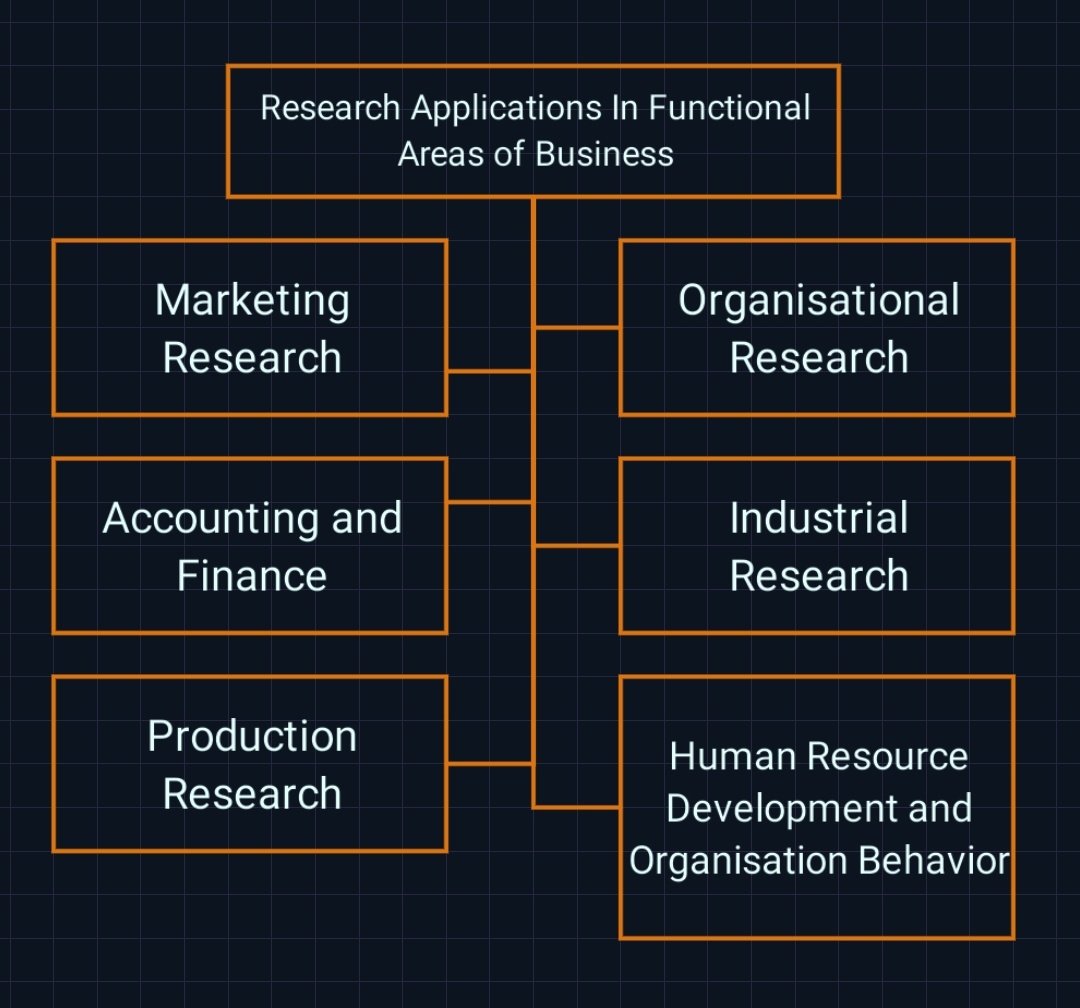
Research Applications in Functional Areas of Business :
Research methodology is a broad term with wide range of applicability in disciplines like, psychology, biology, mathematics, etc, Research can be conducted either to discover or explain a theory or to solve a specific problem faced by management.
1) Accounting and Finance :
Some of the main areas where research is conducted in the field of accounting and finance are :
i) Budgetary control systems,
ii) Designing new practices and methods for inventory costing,
iii) Treatment of depreciation and its effect on earnings,
iv) The practice of transfer pricing and its effects an profitability,
v) Individual’s attitude towards investment decisions,
vii) The effect of mergers and acquisitions on profitability,
2) Human Resource Development and Organization Behaviour :
The areas of human resource and organtisationl behavior are some of the core domains of research. Some of the important issues in which research studies are carried-out are as follows :
i) Individual behaviour and interpersonal relations,
ii) Attitudes of employees,
iii) Leadership characteristics and styles,
v) Assessment centre and evaluation.
3) Marketing Research :
There is widespread use of research in marketing. The company base all of its marketing strategies and initiatives on the basis of consumer tastes and preferences, which can be understood with the help of various researches conducted to get n in-depth knowledge about it. Marketing research can be carried-but for varied like consumer behavior, consumer attitudes, advertising effectiveness, distribution channel efficiency, sales analysis, new product development, etc.
Some specific examples of marketing research are :
i) Forecasting the demand for products,
ii) Analysing the buying behaviour of consumers,
iii) Measuring the effectiveness of advertising,
iv) Decisions regarding media selection for proper advertising,
v) Market testing for new products,
vi) Decisions related to positioning strategies for a product,
vii) Estimating the product potential.
4) Organisational Research :
The organisational research is a field that constitutes many disciplines. In an organisation, researchers come from different, backgrounds and hence bring various concepts, tools, and methods for research. It is widely being accepted that the knowledge of research methods is useful for the students who aspire to become managers in future. Organisational research facilitates the managers to explore various theories and findings that are relevant for the organisation. It also helps the managers to increase their problem solving efficiency. Knowing the research fundamentals allow he managers to investigate a problem scientifically, which in turn enhances the efficiency of managers.
5) Industrial Research :
Industrial research is a practical concept and is concerned with the well being of a company. It is a planned effort to gain better information and improve the new and existing products, services and processes. Some of the major areas where industrial research is carried-out are:
i) Finding ways to improve the quality of products and services,
iii) Devising new ways to use the available resources,
iv) Decisions regarding minimising the cost,
v) Ways to reduce hazards at workplace,
vi) Standardisation of processes,
vii) Developing strategies for improving the relations with customers and public.
6) Production Research :
The production function in an organisation is dynamic in nature and needs continuous improvement in process, product design, cost etc. But these changes and improvements lead to some complexities, which can be resolved by production research. Production research is conducted in following areas :
i) Finding new and better production methods,
ii) Ways to standardise and control the production,
iii) Finding strategies and methods troubleshooting.
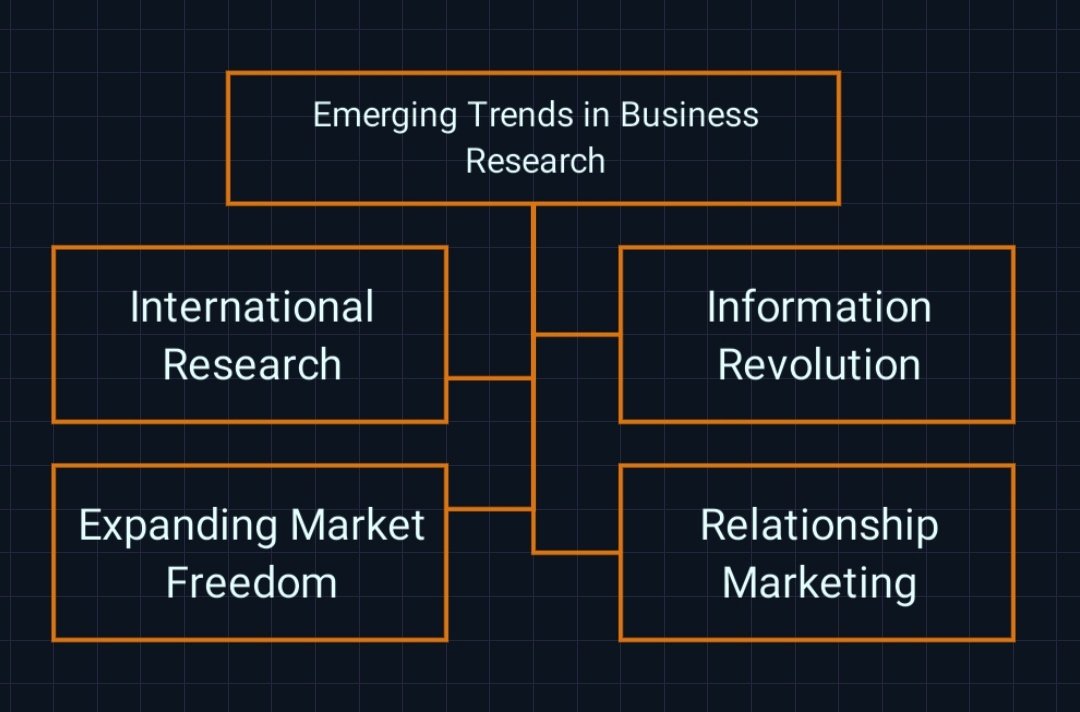
Emerging Trends in Business Research :
1) Expanding Market Freedom :
An important factor responsible for organisations designing products as per consumer’s needs is the emergence of competitive and free markets. Organisations are focusing on improving quality which needs suggestions of employees as well as consumers. The market share and product line are being expanded by organisations through research input. The benefits obtained from business research are greater than the benefits obtained from similar studies conducted in developed countries. Research has become an integral part of the effective decision-making process while organisations draw advanstages from enhanced decision-making.
2) International Research :
On the global scenario, countries have been benefited though the use of business research. The decisions to be taken in unfamiliar cultures are also influenced by this research. For example, an organisation can take decisions regarding acquisition in a foreign county only when it is aware of the economic market structure of that country. Globalisation drives an organisation to think internationally. Moreover, there are verbal as well as non-verbal communication barriers which make the organisation’s decision pertaining to consumer’s and employees in overseas country more complex and difficult. Thus, there is a need to conduct a research regarding the differences in cultures.
3) Relationship Marketing :
Nowadays, businesses are entering into the era of relationship marketing. The concept of relations marketing significantly emphasise upon building and maintaining long term relationship with stakeholders of the company by recognising the mutual benefits of both the stakeholders and the company. There is a change in research concepts due to relationship marketing regarding what and whom to study. Concepts like customer churn and customers share have, revolutionised the traditional research concept and researchers are now extending their loyalty ideas towards population of customers and other stakeholders. Customer churn is the turnover rate of customers, compounded annually, while customer share is the portion of resources used by a customer with single company. For example, a customer who visits McDonalds six out of ten times has a customer share of 60%. Various companies are also emphasising and researching on customer commitment. It is the extent to which customers recognise their values to a company. Focusing on emerging relationship development aspects and relationship marketing concepts is very important for sustenance of a firm and has now becoming a regular trend in the business world.
4) Information Revolution :
Information technology has created a tremendous change in the overall business environment and has completely changed the way in which world does business. It has facilitated and developed several research processes. Due to recent technological advancements, there is an increase in the efficiency level of research.
IT Developments, Which has Affected the Techniques and Methods of Business Research :
Explained below are some of the IT developments, which has significantly affected the techniques and methods of business research :
1) Internet :
Popularly known as “Network of Networks”, internet has drastically changed the aspects of business research and data collection procedures. Internet is an information super highway, which connects businesses and individuals all around the globe. It provides reliable and complete information on any imaginable or possible topic.
2) E-mail :
E-mail or Electronic mail is the way in which individuals send and receive messages in electronic form. These messages are known as mails, and sent or received through computer-network system, thus known as electronic mails. By using e-mails individuals can easily and speedily communicate with each other, irrespective of their geographical distances.
3) Intranet :
An intranet connects the internal computer systems of an organisation with each other. It is the network system through which employees of an organisation can communicate with moving at each other’s physical locations. connects internal information network of a firm and simultaneously prevents outsider’s access.
4) Browsers :
A browser is a software application which is used for retrieving presenting and transferring electronic information resources on the internet. Such information consists of hypertext documents, which includes web links that connects different web files.
5) Websites :
Websites are the sets of various related web pages, which include information in the form of texts, images, audios, videos, etc. In current scenarios, nearly all companies create their own websites to share their information, advertise and offer their products and services and to maintain customer relations by providing online customer support.