
WHAT IS QUANTITATIVE TECHNIQUES ?
Decision Science is the application that uses scientific approach and solves the management problems. It also helps managers to make best decisions. Decision science includes a large number of mathematically oriented techniques. These techniques can be either developed within field of decision science or taken from other disciplines. Decision science is a recognized and established discipline in business. Decision science is a technique which is mainly used within business for increasing their efficiency and productivity.
In various surveys of businesses, many indicate that they use decision science techniques, and most rate the results to be very good.
Decision science is also known as operations research, quantitative techniques, quantitative analysis and management sciences. It is largely used in daily routine of most programs of business organization.
Contents :
- Meaning & Definition of Quantitative Techniques.
- Role of Quantitative Techniques in Decision Making.
- Characteristics of Quantitative Techniques.
- Scope of Quantitative Techniques.
- Nature of Quantitative Techniques.
- Importance of Decision Science / Quantitative Techniques.
- Limitations of Quantitative Techniques in Business Decision Making.
- Applications of Quantitative Techniques.
Meaning and Definition of Quantitative Techniques :
The term Decision Science / Quantitative Techniques (QT) /Operations Research (OR) describes the discipline that is focused on the application of Information Technology (IT) for well-versed decision-making.
Quantitative techniques are those statistical and programming techniques: which support the decision making process especially related to industry and business. QT takes into consideration the elements of qualities such as use of numbers, symbols and other mathematical expressions. QT is basically helpful enhancement to judgment and intuition. Quantitative techniques assess planning factors and alternatives as and when they arise rather than suggest courses of action.
Quantitative, techniques may be defined as those techniques which provide the decision maker with a systematic and powerful means of analysis and help, based on quantifiable data, in exploring policies for achieving pre-determined goals. ”Quantitative techniques are mainly appropriate to problems of complex business enterprises”.
QT can be considered as the scientific approach to managerial decision making. This approach starts from raw data and after manipulation or processing, information is produced which is valuable for making decision.
The main aim of quantitative analysis is the processing and manipulating of raw data into meaningful information. For increasing the use of quantitative analysis, computer can be used as an instrument.
According to C.R. Kothari :
“Quantitative Techniques may be defined as those technique which provide the decision maker with a systematic and powerful means of analysis and help, based on quantitative in exploring policies for achieving per-determined goals”.
Quantitative Techniques are the devices developed on the basis of mathematical and statistical models.
Role of Quantitative Techniques in Decision Making :
The major roles of quantitative technique are as follows :
- It provides a tool for scientific analysis.
- It offers solutions for various business problems.
- It enables proper deployment of resources.
- It supports in minimizing waiting and servicing costs.
- It helps the management to decide when to buy and what is the procedure of buying.
- It helps in reducing the total processing time necessary for performing a set of jobs.
Characteristics of Quantitative Techniques :
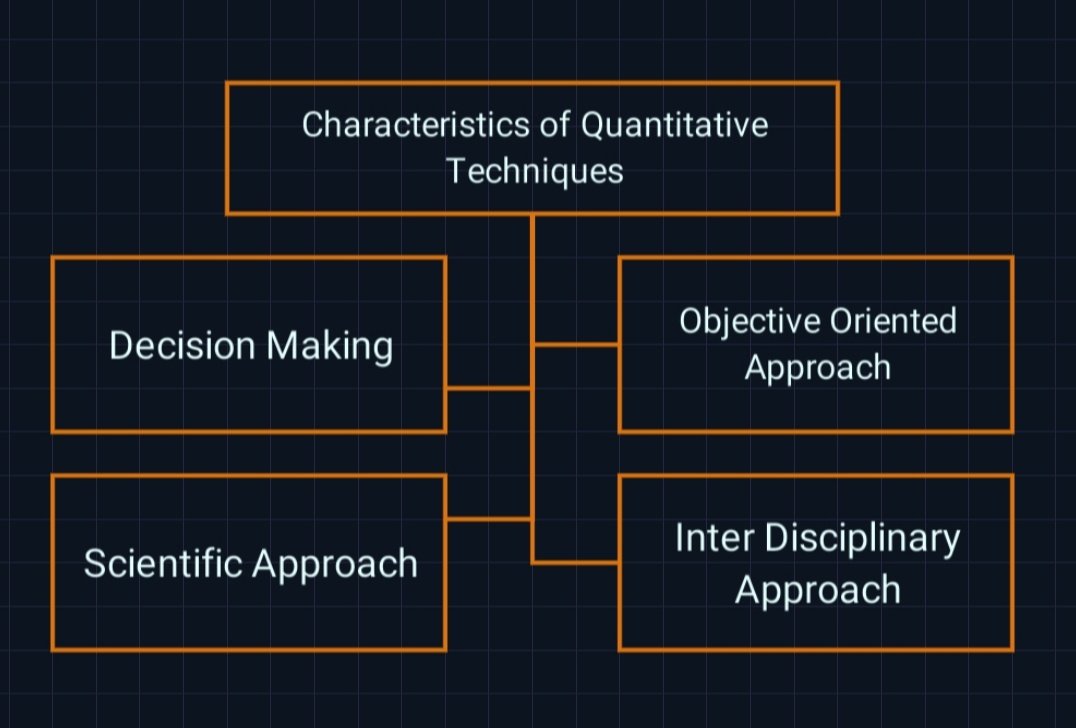
1) Decision-Making :
Decision-making or problem solving constitutes the major working of operations research: Managerial decision-making is considered to be a general systematic process of operations research (OR).
2) Scientific Approach :
Like any other research, operations research also emphasizes on the overall approach and takes into account all the significant effects of the system. It understands and evaluates them as a whole. It takes a scientific approach towards reasoning. It involves the methods defining the problem, its formulation, testing and analyzing of the results obtained.
3) Objective-Oriented Approach :
Operations Research not only takes the overall view of the problem, but also endeavor’s to arrive at the best possible (say optimal) solution to the problem in hand. It takes an objective-oriented approach. To achieve this, it is necessary to have a defined measure of effectiveness which is based on the goals of the organization. This measure is then used to make a comparison between alternative solutions to the problem and adopt the best one.
4) Inter-Disciplinary Approach :
No approach can be effective, if taken singly. OR is also inter-disciplinary in nature. Problems are multi-dimensional and approach needs a team work. For example, managerial problems are affected by economic, sociological, biological, psychological, physical and engineering aspect. A team that plans to arrive at a solution, to such a problem, needs people who are specialists in areas such as mathematics, engineering, economics, statistics, management, etc.