Regressive Tax | Examples, Pros, Cons & How to Calculate ?

A tax that is consistently imposed and levies a higher percentage of revenue from low-income earners than from middle- and high-income earners is said to be regressive. A regressive tax reduces the tax burden as income increases. Regressive taxes can have a significant impact on lower-income individuals and families who may struggle to afford basic … Read more

Tax Shield | Formula, Types, Examples & How to Calculate ?

Tax shields is a strategy used by companies to reduce their taxable income and therefore, lower their tax liability. Tax shields can be an important factor in a company’s financial planning and decision-making. By reducing their tax liability, companies can increase their after-tax earnings and improve their overall financial performance. Find out more about Tax … Read more

Tax Loss Harvesting | Limit, Example, Benefits & How to Harvest?

What is Tax Loss Harvesting ? Tax loss harvesting is a strategy employed by investors to minimize their tax liabilities by strategically selling investments that have incurred losses. The basic premise behind tax loss harvesting is to offset capital gains by selling investments that have declined in value, thereby generating capital losses. These losses can … Read more

Flat Tax | Types, Example, Formula, Benefits & How to Calculate?

Flat Tax


Flat taxes refer to a type of tax system where a single tax rate is applied uniformly to all individuals or entities. It is called a “flat” tax because the tax rate remains constant and does not vary based on income brackets or levels. Find out more about flat tax system below.


What is a Flat Tax ?

A flat tax is a type of tax system in which the tax rate is the same for all individuals or entities, regardless of their income or financial status. Under a flat tax, everyone pays the same percentage of their income in taxes, regardless of whether they earn a little or a lot. It is also known as a proportional tax because the tax burden is proportional to one’s income.

In a flat tax system, the idea is to simplify the tax structure and promote fairness by treating everyone equally. It aims to eliminate the complexity of progressive tax systems with multiple tax brackets and various deductions or exemptions. Proponents argue that flat taxes can enhance transparency, reduce administrative costs, and provide individuals with clear incentives to work, save, and invest.

However, flat taxes can also face criticism. Critics argue that they can be regressive, placing a larger burden on lower-income individuals, as a fixed percentage of their income represents a larger portion of their overall earnings compared to higher-income individuals. Critics also contend that a flat tax may lead to a reduction in government revenue, potentially impacting public services and welfare programs.

How Does the Flat Tax Work ?

In a flat tax system, the basic principle is that everyone pays the same percentage of their income as taxes. The implementation and specifics of flat tax systems can vary across different countries and proposals. Here’s a simplified explanation of how a flat tax works:
1) Single Tax Rate: 
Under a flat tax, there is typically a single tax rate that applies to all income levels.
2) Calculation of Tax Liability: 
To calculate the tax liability, an individual multiplies their taxable income by the flat tax rate.
3) Universal Application: 
The flat tax rate applies to all types of income, including wages, salaries, capital gains, and dividends. There are usually no deductions, exemptions, or credits, as they would complicate the simplicity of the system.
4) Revenue Generation: 
The total tax revenue generated in a flat tax system depends on the tax rate and the taxable income of the population. Higher-income individuals who earn more will contribute more in taxes due to their higher incomes, while lower-income individuals will contribute less due to their lower incomes.
5) Potential Impact:
Proponents argue that a flat tax system promotes simplicity, transparency, and fairness by treating everyone equally. However, critics argue that it can disproportionately burden lower-income individuals because a fixed percentage of their income represents a larger portion of their overall earnings compared to higher-income individuals.

Types of Flat Tax


There are different variations of flat tax, and here are some common types:
1) Pure Flat Tax: 
Under this system, all individuals or households pay the same percentage of their income as taxes. For example, if the flat tax rate is 15%, everyone, regardless of their income, would pay 15% of their earnings as tax.
2) Modified Flat Tax: 
This type of flat tax allows for certain exemptions or deductions to be applied before calculating the tax liability. These exemptions or deductions can be based on factors such as family size, dependents, or specific expenses. The basic principle of a flat tax rate for everyone still applies, but some adjustments are made to accommodate individual circumstances.
3) Consumption-Based Flat Tax: 
Instead of taxing income, a consumption-based flat tax taxes spending or consumption. Individuals are taxed based on the money they spend on goods and services, rather than their income. This type of flat tax aims to encourage saving and investment by not taxing income that is saved or invested.
4) Proportional Flat Tax: 
In a proportional flat tax system, the tax rate remains constant, but the absolute amount of tax paid increases as income increases. For example, if the flat tax rate is 20%, someone earning $50,000 would pay $10,000 in taxes, while someone earning $100,000 would pay $20,000.

Flat Tax Rate

The specific flat tax rate can vary depending on the country or jurisdiction. Some countries that have implemented a flat tax rate include Russia, Estonia, and several countries in Eastern Europe. In these cases, the flat tax rates range from around 13% to 33%.

The choice of implementing a flat tax or a progressive tax system is a matter of policy and can have various economic and social impacts. Different countries and jurisdictions have different approaches to taxation, and the specific tax rates and systems can vary accordingly.

It’s important to note that the implementation of a flat tax system involves various considerations, such as defining what counts as taxable income, addressing potential regressiveness, and ensuring the system generates sufficient revenue to fund government operations and services. These factors can vary depending on the specific design of a flat tax system in different countries or proposals.

Flat Tax Formula

The formula for calculating tax liability under a flat tax system is relatively straightforward. It involves multiplying the taxable income by the flat tax rate expressed as a decimal. Here’s the formula:
Tax liability = Taxable income x Flat tax rate
Let’s break down the formula:
1) Tax liability: 
This represents the amount of tax that an individual or entity owes under the flat tax system.
2) Taxable income: 
This refers to the portion of income that is subject to taxation. It is usually calculated by subtracting any deductions or exemptions from the total income.
3) Flat tax rate: 
This is the single tax rate applied to all income levels in a flat tax system. It is expressed as a decimal. For example, if the flat tax rate is 20%, it would be written as 0.20.
By plugging in the appropriate values into the formula, you can calculate the tax liability under a flat tax system. Remember to ensure that the taxable income and flat tax rate are expressed in the same units (e.g., both in dollars or percentages) to obtain accurate results.

Flat Tax Example

Let’s consider a hypothetical example to illustrate how a flat tax works:
Assume a country implements a flat tax rate of 20% for all individuals, regardless of their income level. Here’s how the flat tax would be applied:
Income Calculation:
  • Person A earns $40,000 per year.
  • Person B earns $80,000 per year.
Tax Calculation:
  • Person A: Since the flat tax rate is 20%, Person A would pay 20% of their income in taxes. In this case, it would be $40,000 multiplied by 20%, which equals $8,000.
  • Person B: Similarly, Person B would also pay 20% of their income in taxes. Therefore, Person B’s tax liability would be $80,000 multiplied by 20%, resulting in $16,000.
In this example, both Person A and Person B pay taxes at a rate of 20%, regardless of the difference in their income levels. The flat tax rate of 20% applies uniformly to all taxable income.
It’s worth noting that the specific tax rate and income thresholds can vary in real-world flat tax systems, and additional factors may come into play, such as exemptions or adjustments. This example provides a simplified illustration of how a flat tax could work.

Read more

Tax Evasion | Examples, Penalties & How to Report ?

Any deliberate act of noncompliance with tax laws that involves hiding or misrepresenting information to reduce the amount of tax liability owed can be considered tax evasion. Tax evasion is illegal and can have serious consequences. If you are unsure about your tax obligations. It is recommended that you consult with a qualified tax professional … Read more

Charges of GST – GST Rates, Composition Scheme, RCM

Charges of GST

Contents :

  1. Intra-State & Inter-State Supply.
  2. Extent & Commencement of GST Law.
  3. Levy & Collection of CGST & IGST (Sec 9 of
    CGST Act & Sec 5 of IGST Act).
  4. Meaning of Reverse Charge Mechanism (RCM).
  5. List of Services And Goods Notified Under RCM [Sec 9(3) Of
    CGST Act & 5(3) Of IGST Act
    ].
  6. Rates of GST.
  7. Composition Scheme [Section 10].
  8. Conditions & Restrictions for Composition Levy
    [Rule 5].
  9. Validity of Composition Levy (Section 10(3) R/W
    Rule 6).
  10. Penalty For Irregular Availment of Composition
    Scheme Sec 10(5) R / W Rule 6(4) & 6(5).
  11. Intimation of Opting for Composition Levy Rules 3
    & 4.
  12. Composition Scheme for Service Providers (NN
    2/2019).

IMPORTANT DEFINITIONS :

Exempt Supply (Sec 2(47) of CGST Act) :

  • Means supply which attracts nil rate of tax).
  • Which may be wholly exempt from tax u/s 11, or u/s 6 of IGST Act.
  • Includes non-taxable supply.

Reverse charge [Section 2(98) of CGST Act] :

  • Liability to pay tax is on ‘recipient’ of supply of G/&S instead of supplier of such G/&S.

India :

  • Territory of India &,its territorial waters (TWI).
  • Seabed & sub-soil underlying such waters.
  • Continental shelf.
  • Exclusive economic zone or any other maritime zone.
  • Air space above its territory & TWI.

Intra-state & Inter-State supply :


Particulars

Intra-State Supply

Inter-State Supply

Meaning

Location of supplier & PoS are in

i) Same UT

ii) Same State


Location of supplier & PoS are in

i) Different States

ii) Different UTs

iii) A State & a UT [MH > A&N]

Applicability

CGST + SCGT/(UTGST for UTs)

IGST


EXTENT & COMMENCEMENT OF GST LAW :


CGST Act :
It extends to whole of India including J&K.

SGST Act :
SGST Act of a State/UT with State Legislature extends to whole of that State/UT.

IGST Act :
It extends to the whole of India including J&K.

UTGST Act :
It extends to All UTs without state legislature.

Note : UTs without state legislature are: Andaman & Nicobar, Lakshadweep, Dadra & Nagar Haveli, Daman & Diu, Chandigarh.

LEVY & COLLECTION OF CGST & IGST (Sec 9 of CGST Act & Sec 5 of IGST Act) :


Section

Levy & Collection

9(1)

Levy of CGST on
Intra-State Supply on the value determined u/s 15 (Max @ 20%)

  • There shall be levied a tax called CGST on all intra-State supplies of
    G/&S.
  • Except on alcoholic liquor for human consumption.
  • On value determined u/s 15.
  • At such rates notified by Government on recommendations of GST Council
    (Max. 20).
  • Collected in such prescribed manner.

9(2) 

No Levy of GST on
‘petroleum products’ till recommended by GST council.

9(3)


Power of Government to specify
category of Supply on which RCM shall apply

  • Government may, on recommendations of GST Council, by notification.
  • Specify categories of supply of G&/S on which GST shall be paid on
    reverse charge basis by recipient of such G/&S.
  • All provisions of this Act shall apply to such recipient as if he is liable for paying tax in relation to supply of such G/&S.

9(4) (AMD)

Tax under RCM is payable on-Notified category of Inward Supplies, of
G/& S received from any unregistered supplier by Notified class of
registered persons

  • Government may, on recommendations of GST Council, by notification.
  • Specify a class of registered persons who shall, in respect of supply of
    specilied categories of goods or services or both received from an
    unregistered supplier.
  • Pay the tax on RCM basis as the recipient of such supply of goods or
    services or both.
  • All the provisions of this Act shall apply to such recipient as if he is
    the person liable for paying the tax in relation to such supply of goods or
    services or both.

9(5)

Payment of GST by electronic commerce
operator (ECO)

  • Government may on recommendation of GST
    council by notification.
  • Specify categories of services the tax
    on intra state supplies of which shall be paid by electronic commerce
    operator (ECO) if such services are supplied through it.
  • All provisions of this act shall apply
    to such ECO as if he is supplier liable for paying tax in relation to supply
    of such services.

Situation

Person liable to pay tax

If ECO does not have a physical presence in TT

Person representing such ECO for any purpose in
TT

If ECO does not have a physical presence in TT
and also he does not have a representation.

Person appointed by ECO in TT.


 Notified Services are :

  • Transportation of Passengers by a radio-taxi,
    motorcab, maxicab and Motor cycle.
  • Hotel Business (Unregistered).
  • House Keeping Services (Unregistered).

Meaning of ECO :

  • ECO is any person who owns/operates/manages an electronic platform for supply of G/&S.
  • ECO display products & services on their electronic portal which are actually supplied by some other person to the consumer.
  • Consumers buy such goods/services through these portals.
  • On placing order for a particular product/service, actual supplier suppliers supplies selected product / service to consumer.
  • Price is collected by ECO from consumer and thereafter given to actual supplier after deduction their commission.
Q. A hotel provided accommodation in Himachal Pradesh, through ECO – Makemyyatra.com. Hotel is not liable to get registered as per the provisions of Section 22 (1) of the CGST Act. Who is the person liable to pay GST in this case? Will your answer be different if ECO Makemyyatra.com does not have a physical presence in India?

Ans : As per Section 9(5), person liable to pay GST is EcO i.e. Makemyyatra.com. All the provisions shall apply to such ECO as if he is the supplier liable for paying tax in relation to the supply of such services. If Makemyyatra.com does not have a physical presence in India, person liable to pay tax is the person representing Makemyyatra.com.

WHAT IS THE REVERSE CHARGE MECHANISM (RCM) :


  • Reverse charge means the liability to pay tax is on the recipient of supply of G/S instead of the supplier.
  • Generally, supplier is liable to pay GST. However, under RCM, liability to pay GST is on recipient of G/S.
  • However, underlying principle of an indirect tax is that burden of such tax has to be ultimately passed on to the recipient. GST being an indirect tax, this principle holds good for GST. Therefore, under RCM, only the compliance requirements, (i.e. to obtain registration under GST, deposit the tax with the Government filing returns, etc.) have been shifted from supplier to recipient.
There are two type of reverse charge scenarios provided in law.

Sec. 9(3) :
Supply of specified categories of goods or services is covered by section 93) of CGST Act.

Sec. 9(4) :
Supply of specified categories of G/S made by an unregistered supplier to specified class of registered recipients is covered by section 9(4) of CGST Act.

GOODS NOTIFIED UNDER RCM [Sec 9(3) of CGST Act & 5(3) of IGST Act] :


  • Cashewntats (not shelled/peeled).
  • Bidi wrapper leaves & tobacco leaves.
  • Supply of Lottery, Silk yarn, used vchicles.
  • Seized and Conficated goods.
  • Old &used goods.
  • Waste & scrap.
  • Raw cotton, etc.

SERVICES NOTIFIED UNDER RCM [Sec 9(3) of CGST Act & 5(3) of IGST ACT] :


SN.

Nature of Service


Supplier (BY)


Recipient [Person liable to pay GST]

1

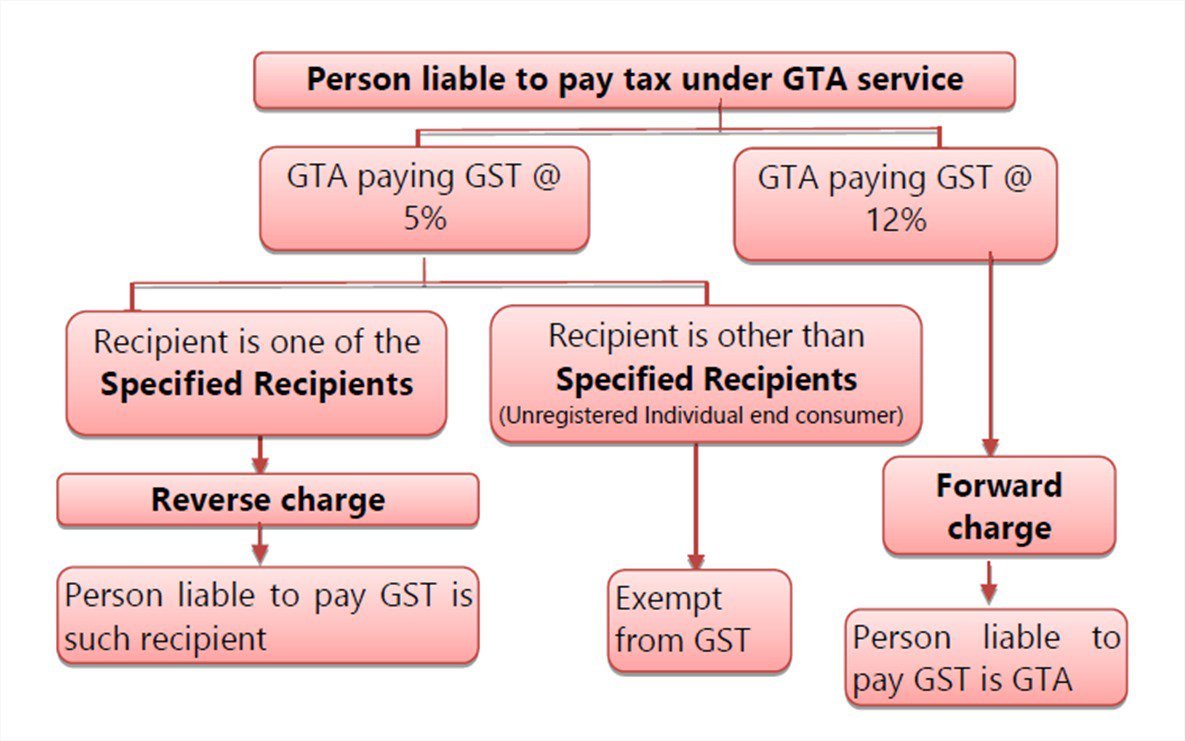
Goods Transport Agency (GTA) Goods by Road

  • who has not paid CGST@ 6%.
  • who has not availed ITC.


Goods Transport Agency paying 2.5% CGST


  • Factory (Factories Act, 1948).
  • Society (Societies Registration Act).
  • Co-operative society.
  • Any Corporate Body.
  • P’ship Firm (including AOP/BO).
  • Casual Taxable Person in TT.
  • Registered Person under GST.


AMD : NO RCM on Transportation services provided by GTA to
Department /establishment of CG/SG/UT; LA; Governmental agencies which has
taken registration under GST only for the purpose of deducting tax u/s 51
& not for making a taxable supply of goods or services.

Note: Above services have been simultaneously exempted from
payment of tax.


Meaning of Recipient : Person who pays or is liable to pay freight for the
transportation of goods by road in goods carriage, located in TT shall be
treated as the person who receives the service for the purpose of this
notification.

Q. ABC Ltd. availed service of XYZ Ltd. (GTA)
for transportation of goods by road from Pune to Mumbai.

Ans: GST shall be paid by ABC Ltd. under RCM u/s
9(3) since it is liable to pay freight for transportation of goods. Thus ABC
Ltd. shall be treated as recipient ofservice. If GTA has paid GST under
forward charge @ 129% then it is not subject to reverse charge.

2.

Legal Services 

Individual Advocate (including senior advocate or firm of advocates)

Business Entity located in TT.

3

Services by Arbitral Tribunal

Arbitral Tribunal

Business Entity located in TT.

4

Sponsorship

Any Person


Body Corporate or P’ship Firm in TT

Q.ABCLtd.
paid Rs: 1,00,000 towards sponsorship of exhibition. What if Mr. A has paid
Rs. 1,00,000 towards sponsorship of exhibition?

Ans:
Sponsorship is received by ABC Ltd. so they are subject to reverse charge U/s
9 (3). If it is provided Mr. A then GST will be payable by supplier of
service. Service provided by way of sponsorship to any body corporate or
partnership firm are subject to reverse charge.

5

Services supplied by CG, SG, UT/LA

CG, SG, UT, LA

Business Entity located in TT.


Excluding [No RCM in case of supply of these services]

a) Renting of Immovable Property

b) Specified services:

  1. Services by Department of Posts by way of Speed post, Express parcel
    post, Life Insurance & Agency Services provided to any person other than CG,
    SG, UT or LA.
  2. Services in relation to Vessel/Aircraft, inside/outside the precincts
    of a port/ airport.
  3. Transport of Goods/ Passengers.

5A

Services supplied by CG, SG, UT or LA way of renting of immovable
property

CG, SG, UT or LA

Any Registered Person under GST


Q. Rental income received by Tamil Nadu State Government from renting an
immovable property to Mannappa Pvt. Ltd. (Turnover of the company was
Rs. 22 lacs in preceding FY).

Ans : In case of Services supplied by CG/SG/UT/LA by way of renting of
immovable property to a registered person, RCM will be applicable (i.e
recipient will be liable to pay GST). Hence, Mannappa Pvt. Ltd. will be
liable to pay GST under reverse charge mechanism.

5B


Services of Transfer of development rights or Floor Space Index (FSI) for
construction of a project by a promoter.

Any person


Promoter


5C


Long term lease of land(> 30 years) against consideration in the form
of upfront amount (called as premium, salami, cost price, development charges
or by any other name) &/or periodic rent for construction of a project by
a promoter.

Any person


Promoter


6

Services supplied by a Director

Director


Company or Body Corporate

7

Services supplied by Insurance Agent

Insurance Agent

Insurance Company located in TT.

Q. Insurance company pay Rs. 1,00,000 commission to Mr. A whose turnover
< threshold limit for registration.

Ans. : Insurance company will be liable to pay GST under reverse charge
basis u/s 9 (3).

8

Services supplied by Recovery Agent

Recovery agent

Banking company or financial institution or NBFC located in TT.

9

Transfer/permitting use enjoyment of copyright relating to original
literary, dramatic, musical or artistic works.

Author, music composer, Photographer, Artist etc.


Publisher, Music company, Producer

etc. located in taxable territory.


10

Supply of Services by Members of overseeing Committee

Members of Overseeing Committee constituted by RBI


RBI

11

Services supplied by Individual Direct Selling Agents (DSAs)

Individual Direct Selling Agents (DSAs) other than BC, P’ship firm or LLP


Banking company or NBC in TT.

12

Services provided by Business  facilitator
to a banking company

Business facilitator

Banking company, located in TT.


13

Services provided by Agent of Business correspondent

Agent of Business correspondent

Business Correspondent located in TT


14

Security Services (Services Supply of security personnel)

Any Person other than BC

Any Registered Person, located in TT


Note : Tax has to be paid under RCM on
gross amount charged (Security Personnel cost + PF+ ESI+Service charges +
other charges) by security service providers & not on service charges
only.


However, nothing contained in this entry shall apply to :

  • Department or Establishment of CG/SG/UT; LA; Governmental agencies (which
    has taken registration only for deducting tax u/s 51 & not for making a
    taxable supply of G&/S).
  • Registered person paying tax under composition scheme (Composition
    Dealer).

PERSON LIABLE TO PAY TAX UNDER GST

Q. State the person liable to pay GST provided recipient is located in taxable territory & it is intra-state supply :

(a) Service of transportation of goods by road provided by GTA (registered) provided to a company (GST Registered).
(b) Service of transportation of goods by road by GTA (unregistered) provided to a company (GST Registered).
(c) Mr. A is a senior advocate in Calcutta High Court. During Oct. 2018, he provides legal service to ABC associates (a firm of advocates in Mumbai) for a fee of Rs. 5,00,000. Turnover of ABC associates for preceding FY is Rs. 36 lacs.
(d) Services provided by an arbitral tribunal to any business entity.

Answer :
(a) Yes, recipient company shall be liable to pay GST since GTA services have been subject to RCM as per sec. 9(3). Thus even if GTA is GST registered, his service to company (company is body corporate) shall attract RCM.
(b) Yes, recipient company shall be liable to pay GST scenes GTA service have been subject to RCM as per section 9(3). Service of transportation of goods by road by GTA to a body corporate shall attract RCM. Thus in given case even if GTA is GST unregistered his service to company ( company is body corporate) shall act reverse charge.
(c) Legal services provided by senior advocate to a business entity is exampt if aggregate turnover in preceding financial year of such business entity is upto rupees 20 lacs. In the given case advocate firm is a business entity with aggregate turnover exceeding Rs. 20 Lacs. Thus, services to such advocate firm is not exempt & thus G5T shall be payable. However, such service are subject to revepse chargehere client of advocate firm shall be deemed to be the recipient of such service (he being the actual litigant/applicant) & hence, shall be liable to pay GST on services of senior advocate.
(d) Since GST on services provtted or agreed to be provided by an arbitral tribunal to aly business entity located in TT is payable under RCM. In the given case GST payable by the recipient business entity.

RATES OF GST :


In order to determine the rate applicable on a particular supply of goods or services, one needs to first determine the classification of such goods or services.

CLASSIFICATION OF GOODS :

  • Classification of goods means identification of the tariff item, sub-heading, heading & chapter in which a particular product will be classified.
  • Tariff item, sub-heading, heading & chapters referred in the Schedules of rate notification for goods under GST a the Tariff item, sub-heading, heading & chapters of the First Schedule to the Customs Tariff Act, 1975.
  • Indian Customs Tariff is based on HSN. HSN stands for Harmonized System of Nomenclature.
  • It is a multipurpose international product nomenclature developed by the World Customs Organization (WCO) for the purpose of classifying goods across the World in a systematic manner.
  • It comprises of about 5,000 commodity groups; each identified by a 6-digit code [code can be extended), arranged in a legal & logical structure & is supported by well-defined rules to achieve uniform classification.
  • India has developed an 8-digit code of HSN.
  • Along the lines of HSN, the Indian Customs Tariff has a set of Rules of Interpretation of the First Schedule & General Explanatory notes. These rules & the general explanatory notes give clear direction as to how the nomenclature in the schedule is to be interpreted. These Rules for Interpretation including section & chapter notes & the General Explanatory Notes of the First Schedule apply to the interpretation of the rate notification for goods under GST also.
  • Consequently, under GST, goods are classified on the basis of HSN in accordance with the Rules for Interpretationd the Customs Tariff.
  • Once classification fora product has becn determined on this basis, applicable rate has to be determined as per the rate prescribed in the rate notification issued under GST.

CGST

0%

0.125%

1.5%

2.5%

6%

9%

14%

SGST

0%

0.125%

1.5%

2.5%

6%

9%

14%

TOTAL

0%

0.250%

3%

5%

12%

18%

28%


CLASSIFICATION OF SERVICES :

  • A new Scheme of Classification of Services has been devised under GST. It is a modified version of the United Nations Central Product Classification.
  • Under this scheme, the services of various descriptions have been classified under various sections, headings & groups. Chapter 99 has been assigned for services. This chapter has following sections :

Section 5

Construction Services.

Section 6

Distributive Trade Services; Accommodation, Food
& Beverage Service; Transport Services; Gas & Electricity
Distribution Services.

Section 7

Financial & related services; real estate
services; & rental & leasing services.

Section 8

Business & Production Services.

Section 9

Community, social & personal services &
other miscellaneous services.

  • Each section is divided into various headings which is further divided into Groups. Its further division is made in the form of Tariff item’/ Service Codes. Rate of tax is determined as per the Service Code in which the service is classified.
  • Gambling Services, Services of admission to entertainment events/sporting event attract 28% GST.
  • Services not covered under any specific heading are taxed @18% (CGST@9% & SGST @ 9%).

CGST

0%

2.5%

6%

9%

14%

SGST

0%

2.5%

6%

9%

14%

TOTAL

0%

5%

12%

18%

28%


What is GST Return? | Purpose, Modes, Types of GST Returns

GST

Contents :

  1. Purpose and Modes of Filing Returns under GST.
  2. List of Various Types of Returns under GST Law.
  3. GSTR 1 : Details of Outward Supplies.
  4. GSTR 2 : Furnishing Details of Inward Supplies.
  5. GSTR 3 & 3B : Monthly Return.
  6. GSTR 4 : Return for Composition Supplier and Person Paying Tax under NN 2/2019.
  7. GSTR 5 : Return for Non-Resident Taxable Person.
  8. First Return (Section 40) and Annual Return (Section 44).
  9. GSTR 10 : Final Return.
  10. GSTR 11 : Details of Inward Supplies of Person Having UIN.
  11. Default in Furnishing Return (Section 46 & 47).
  12. Rectification of Errors or Omissions (Section 39(9)).
  13. Goods and Services Tax Practitioners (Section 48).

WHAT IS GST RETURN ?


GST return is a document that will contain all the
details of your sales, purchases, tax collected on sales (output tax), and tax
paid on purchases (input tax). Once you file GST returns, you will need to pay
the resulting tax liability (money that you owe the government). 

WHO SHOULD FILE GST RETURN ?

All business owners and dealers who have registered under
the GST system must file GST returns according to the nature of their business
or transactions. 

  • Regular Businesses.
  • Businesses registered under the Composition Scheme.
  • Other types of business owners and dealers.
  • Amendments.
  • Auto-drafted Returns.
  • Tax Notice.

PURPOSE OF FILING GST RETURNS :

  • Mode for transfer of information to tax administration.
  • Compliance verification program of tax administration.
  • Finalization of the tax liabilities of the taxpayer within stipulated period of limitation.
  • Providing necessary inputs for taking policy decision.
  • Management of audit and anti- evasion programs of tax administration.


MODES OF FILING RETURNS :


(All Returns under GST laws are to be filed Electronically)

LIST OF VARIOUS TYPES OF RETURNS UNDER GST LAW :


GSTR

Particulars

Frequency

Due Date

1

Details of
Outward Supplies of taxable G/S (Sec 37)

Monthly


10th of the next
month

2

Details of
inward supplies of taxable G/S effected
claiming ITC (Section 38).

Monthly


15th of the next
month

3

Monthly return
on the basis of finalization of details of outward supplies & inward
supplies along with payment of amount of tax (Sec 39(1)].

Monthly


20th of the next
month

3B

Simple return
for Jul 2017- September 2019

Monthly


20th of the next
month

4

Return for
compounding taxable person (Section 39(2) of the CGST Act, 2017)

Quarterly


18th
of the month succeeding quarter

5

Return for
Non-Resident foreign taxable person

(Section 39(5)
of the CGST Act, 2017)

Monthly


20th of next
month OR within
7 days after last day of the period of registration
specified
u/s 27(1), whichever is earlier

6

Return for ISD :
Section 39(4)

Monthly


13th of the next
month

7

Return for
authorities deducting tax at source
(Section 39(3) of the CGST
Act, 2017)

Monthly


10th of the next
month


8

Details of
supplies effected through ECO & amount
of tax collected

Monthly


10th of the next
month

9

Annual Return
(section 44)

Who Files:
Registered Person (other than ISD,
TDS/TCs Taxpayer, CTP &
NRTP).

Annually


31st December
of next FY


10

Final Return
(Section 45)

(When
registration is cancelled or surrendered)

Once


Within 3 Months of
the date of
cancellation or Date of cancellation order,
whichever
is later

11

Details of
Inward supplies to be furnished by a
person having UIN &
claiming refund.

Monthly


28th of the
month following the
month for which statement is filed


Note : For CA- INTER, only GSTR-1/3B/4/5/9/10 are relevant.

GST | Goods & Service Tax, GST Portal & GSTN, GST Council

GST

Contents :

  1. Why Are Taxes Levied ?.
  2. Difference B/W Direct Tax & Indirect Tax.
  3. Features of Indirect Tax.
  4. History/Genesis of GST.
  5. What is GST ?.
  6. Classification of Goods and Services & GST Compensation Cess.
  7. GST Council: Article 279A.
  8. GST Common Portal & GSTN.
  9. Goods & Service Tax Network.
  10. GST Suvidha Providers/Asps.
  11. Concept/Features of GST in India.
  12. Need, Types of GST In India & Benefits of GST in India.
  13. What Makes GST So Special ? Seamless Flow of Credit in GST with Example.
  14. Taxes to be Subsumed in GST & Takes Not to be Subsumed.
  15. Constitution of India.
  16. Constitutional Provisions For Taxation Purpose.
  17. Framework of GST In India (Dual GST, GST In India, GST Acts, GST Rates).


WHAT IS TAX ?

  • A tax may be defined as a pecuniary (monetary) burden laid upon individuals or property owners to support the Government [Black’ s Law Dictionary].
  • It is financial charge (fee) imposed by Government on income, commodity or activity.
  • A tax is not a voluntary payment or donation, but an enforced contribution.
  • Thus it can be said that Tax is “Compulsory Extortion of Money” by government.

WHY ARE TAXES LEVIED ?


  • Taxes constitute basic source of revenue to the Government which are utilized for meeting expenses of Government like defence, provision of education, health-care, facilities like roads, dams etc.
  • They are levied & collected to fulfill the soci-economic objectives of the government.

DIFFERENCE B/W DIRECT TAX & INDIRECT TAX :


Particulars

Direct Tax

Indirect Tax

Definition

If tax is levied directly on income/wealth of a
person, it is a direct tax.

If tax is levied on price of a good or service, it
is an indirect tax.

Time of Collection


Collected on yearly basis.


Collected at the time of sale/purchase of goods
or rendering of services.

Examples


Income tax, Tax on undisclosed foreign Income or
Assets.


GST, Custom duty.


Burden


There is No Shifting of burden.

Directly borne by the taxpayer.

Burden is shifted to subsequent buyer.

Burden falls on final consumer.

Levied on


Income/wealth of the person.

Price of Goods or Services.

Incidence & Impact


A tax is said to be direct when impact &
incidence of tax are on same person.

A tax is said to be indirect when impact and
incidence of tax are on different person.


FEATURES OF INDIRECT TAX :


1) Wider Tax Base :
Majority of the products or services are subject to IDT with low threshold.

2) Major Source of Revenue : 
In India, IDT contribute> 50% of Total tax revenues of CG & SGs.

3) Tax on Commodities (Goods & Services) :
It is levied on commodities at the time of their manufacture/purchase or sale or import/export & thus it is also called as commodity taxation.
It is also levied on provision of services.

4) Shifting of Burden :
GST paid by the supplier of the goods is recovered from the buyer by including the tax in the cost of the commodity.

5) No Perception of Direct Pinch :
Since the value of IDT is generally in-built in the prices of the commodity, most taxpayers pays them without knowing that they are paying tax to the government.

6) Regressive in Nature :
Indirect taxes are not based on the principle of ability to pay. All consumers (Both Rich & Poor) have to pay same rate of indirect taxes. This may further increase income disparities b/w rich & poor.

7) Inflationary in Nature :
IDT directly affects the prices of commodities & leads to inflationary trend.

8) Promotes Social Welfare :
High taxes on harmful products (sin goods) [Ex: Tobacco & Alcohol products].

9) Reduced Tax Evasion :
Since indirect taxes are already included in price of G&S.

WHAT GST MEANS ?


HISTORY/GENESIS OF GST :

Concept of GST was introduced first of all in France in 1954. In India has adopted its GST model from Canada (DUAL GST Model).

2000 :
Atal Bihari Vajpayee (PM of India) mooted the concept of GST & set up a committee to design GST model for India.

2003 :
CG formed a task force under Vijay Kelkar.

2004 :
Iden of fully integrated National GST was mooted by Kelkar Task Force based on VAT. Taskforce was headed by Vijay L. Kelkar who was advisor to Finance Ministry.

Feb 2006 :
Union Finance Minister, Shri P. Chidambaram announced that GST would be introduced from 1 April 2010 while presenting Central Budget (2006-07).

Mar 2011 :
The Constitution (115th Amendment) Bill, 2011 was introduced in Lok Sabha to give concurrent taxing powers to Union & States. This Bill was subsequently lapsed.

Mar 2013 :
GSTN: A not for Profit, Non-Government, Private Ltd Company was incorporated named Goods & Services Tax Network (GSTN) as Special Purpose Vehicle to provide IT infrastructure & services for implementation of GST.

Dec 2014 :
The Constitution (122nd Amendment) Bill, 2014 seeking to amend Constitution to introduce GST was introduced on 19th Dec 2014.

6 May 2015 :
The Constitution Amendment (122nd) Bill was passed by Lok Sabha on 6 May 2015.

3 Aug 2016 :
It was passed by Rajya Sabha on 3rd August 2016 (with some changes)

8 Aug 2016 :
Changes made were unanimously passed by Lok Sabha on 8th Aug 2016.

8 Sept 2016 :
After Bill was adopted by majority of the State Legislatures (by atleast 50% of the States), final assent of President of India was given on sih Sep. 2016; & The Constitution (122nd Amendment) Bill, 2014 became 1101st Amendment) Act, 2016.

1 July 2017 :
GST law was made applicable in India from 1 July 2017.

8 July 2017 :
GST law was made applicable to J&K from 8 July 2017.

GOODS AND SERVICE TAX :

  • Goods & services tax means any tax on supply of G/&S except on alcoholic liquor for human consumption.
  • Presently, GST is levied on all G/&S except alcoholic liquor for human consumption & Petroleum crude, diesel, petrol, ATF and natural gas.
  • GST will be levied on Petroleum Products (Petroleum crude, High Speed Diesel, Motor Spirit, Natural Gas & Aviation Turbine Fuel) from Notified Date on recommendation of GST Council. Note : Nothing is notified till now & thus NO GST will be levied on above products on date. 

Till such Notified date, Central Excise Duty will continue to be levied on Manufacture/Production of Petroleum Products & their Inter/Intra-State Sale is subject to CST/VAT respectively.


Position of Some Specific Goods as on the date :

Goods

Excise Duty

VAT/CST

GST

Alcoholic liquor for Human Consumption

✔

✔

✘

Petroleum crude, HSD, Motor Spirit, Natural Gas, ATF

✔

✔

✘

Tobacco & Tobacco Products

✔

✘

✔

Other Goods

✘

✘

✔


Note : Real estate sector has been kept out of ambit of GST. (GST will not be levied on sale/purchase of immovable property.

CLASSIFICATION OF GOODS AND SERVICES :


  • HSN (Harmonised System of Nomenclature) is used for classifying the ods under the GST.
  • Chapters referred in Rate Schedules for goods are Chapters of First Schedule to Customs Tariff Act, 1975.
  • A new Scheme of Classification of Services has been devised wherein the services of various descriptions have been classified under various sections, headings & groups.
  • Each group consists of various Service Codes (Tariff).

GST COMPENSATION CESS :


  • GST (Compensation to States). Act, 2017 provides for a mechanism to compensate the States, on account of loss of revenue which may arise due to implementation of GST for a period of 5 year.
  • It is levied by Central Government on Notified goods only on Intra/Inter state supply.
  • It is levied on Specificd Luxury items or Demerit Goods, like pan masala, tobacco, acrated wpters, Coal, Lignite, Motor Cars etc., computed on value of taxable supply.

GST Council: Article 279A :


Constitution and Enforcment :
  • Article 279A empowers President to constitute a joínt forum of Centre & States.
  • The provisions relating to GST Council came into force on 12th Soptember, 2016.
  • The President constituted GST Council on 15th September, 2016.
  • Chairman of GST Council Union Finance Minister.
  • Members of GST council Union Minister of State in charge of Revenue/Finance, Ministers in charge of Finance/Taxation or any other Minister nominated by each States & UTs with SL.

Functions :
Make recommendations to Union & States on important issues like,
  • (a) taxes, cesses & surcharges which may be subsumed in GST.
  • (b) Goods & Services that may be subjected to, or exempted from GST.
  • (c) Model GST Laws, Principles of levy, apportionment of GST & the principles that govern the place of supply.
  • (d) Threshold limit of turnover beclow which G&S may be exempted from GST.
  • (e) Rates including floor rates with bands of GST.
PC Note : Tax rates; Exemptions; Threshold limits; Dispute resolution; GST legislations.

Decision :
  • Every decision of GST Council is taken by a majority of not less than 3/4 th of weighted votes of members present & voting.
  • Vote of Centre has a weightage of 1/3 rd of total votes cast.
  • Votes of all SGs together has a weightage of 2/3 rd of total votes cast, in that meeting.

Article 279A(4)(f) :
  • Special Category States Assam, AP, J&K, Manipur, Meghalaya, Mizoram (MMM), Nagaland, Sikkim, Tripura, Himachal Pradesh (HP), Uttrakhand (UK).

Article 279A(4)(g) :
  • GST council shall recommend the date on which GST shall be levied on Petroleum crude, High specd diesel, Motor spirit, Natural gas & Aviation Turbine Fuel.

GST COMMON PORTAL & GSTN :


GST Common Portal :
  • Common GST Electronic Portal (www.gst.gov.in) a website managed by Goods & Services Network has been set by the Government to establish uniform interface for taxpayer; common & shared IT infrastructure b/w the Centre & States.
  • This portal is one single common portal for all GST related services.
  • It acts as a clearing house to verify claims & informs the respective governments to transfer funds.
  • A common GST system provides linkage to all State/ UT Commercial Tax Departments, Central Tax authorities, Taxpayers, Banks & other stakeholders.
  • The eco-system consists of all stakeholders starting from taxpayer professional to tax officials to GST portal to Banks to accounting authoritics.

Accessibility of Portal :
  • It is accessible over Internet by taxpayers & their CAs/Tax Advocates & over Intranet by Tax officials etc.

Front and Services : 
  • GSTN provides 3 front end services (i) Registration (ii) Payment; (iii) Return.

GOODS & SERVICE TAX NETWORK :


What is GSTN ?

GSTN is a non-Government, private limited campany formed u/s 8 of Companies Act, 2013, (not for profit companies). It is backbone of technology used for GST.

Functions of GSTN [IMP] :

  • Facilitating registration: (Filing of application).
  • Forwarding returns to CG & SG authorities; (Filing of Return).
  • Computation & Settlement of IGST payment [Like a Clearing House).
  • Matching of tax payment details with banking network.
  • Providing various MIS reports to CG & SG based on taxpayer return information.
  • Creation of Challan for tax payment.
  • Providing analysis of taxpayers’ profile; & running matching engine for matching, reversal & reclaim of input tax credit.


Note: All statutory functions like approval of registration, assessment, audit, appeal, enforcement etc. will remain with respective tax departments.

GST SUVIDHA PROVIDERS/ASPs :


  • GSTN has selected certain IT, ITS & financial technology companies, to be called GST Suvidha Providers (GSPs).
  • GSPs develop applications to be used by taxpayers for interacting with GSTN.
  • They facilitate the taxpayers in uploading invoices as well as filing of returns and act as a single stop shop for GST related services.
  • They customize products that address the needs of different segment of users.
  • GSPs may take the help of Application Service Providers (ASPs) who act as a link b/w taxpayers & GSPs.

CONCEPT/FEATURES OF GST IN INDIA :


gst india

1) Value Added Tax : 

Levied on manufacture, sale & consumption of Goods & Services.

2) Continuos Chain of Tax Credit : 
From original producer’s/ service provider’s point upto retailer’s/consumer’s level. Only value added’ at each stage of supply chain is taxed.

3) Burden borne by Final Consumer : 
Final consumer bears the GST charged by the last supplier.

4) No Cascading Effect :
Since, only the value added at each stage is taxed under GST, there is no tax on tax. Moreover, since there is only one tax, there cannot be cascasing effect.

5) No Double (Multiple) Taxation : 
GST does not differentiate b/w goods & services & thus there cannot be double taxation.

6) Uniform Tax Structure all over India : 
One Nation, One Tax, One Market.

NEED FOR GST IN INDIA :


  • Double Taxation of transaction as both goods & services (Fixe Hotel Business, Softwares]. (VAT + ST).
  • Cascading of Taxes due to (i) Non-VATable CST & VAT charged on Value + Excise Duty.
  • Set off of CENVAT & State VAT against the crecht of one nnother was not possible as CENVAT was a central levy & State level VAT was a State levy.
  • Several Local taxes in the states (Ex-Luxury tax, Entertainment tax) were not subsumed in State VAT.
  • Non-integration of VAT & Service Tax: VAT on goods was not integrated with tax on services, at the state level, to remove cascading effect on Service Tax.
  • When goods were manufactured & sold, both Excise duty (CENVAT) & State-level VAT were levied.
  • No CENVAT after manufacturing stage.

BENEFITS OF GST IN INDIA :


(One Nation, One Tax, One Market)
  • Creation of Unified national market.
  • Mitigation of cascading effect.
  • Elimination of double (multiple) taxation – Removal of many Indirect taxes.
  • Boost to make in India initiative – Since Lower cost due to reduced taxes.
  • Increase in government revenue – Since rates of GST are lower & thus more people will pay tax.
  • It will boost export & manufacturing & thus gencrate more employment, leading to rise in GDP.