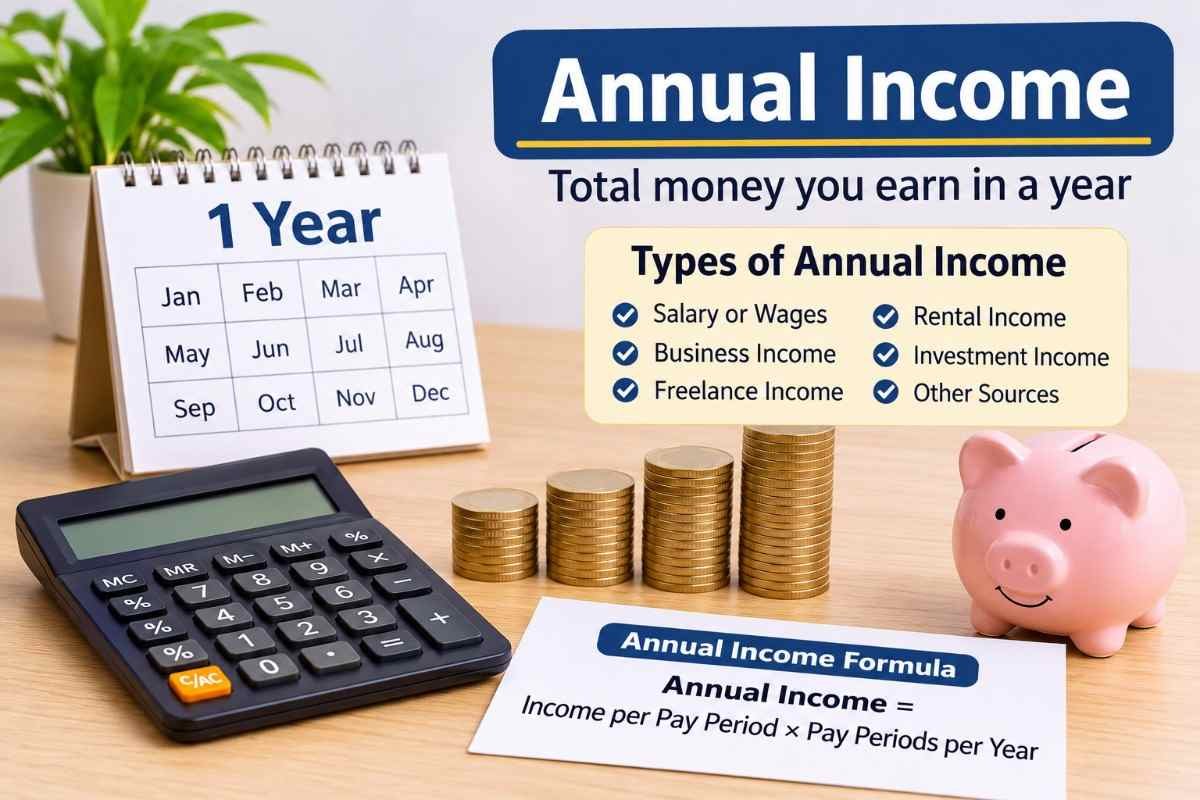
Annual income is an important financial concept that helps people understand how much money they earn in a year. It is commonly used when applying for jobs, renting a home, getting a loan, preparing a budget, or planning future financial goals.
For example, if a person earns $4,000 per month from a job, their annual income from that salary is $48,000 before taxes and deductions.
Understanding annual income can help you compare job offers, manage your expenses, and make better financial decisions.
This guide explains what annual income means, how it works, the different types of annual income, and how to calculate it with simple examples.
What Is Annual Income?
Annual income (commonly known as yearly income) is the total amount of money a person earns or receives during a 12-month period.
It may come from one source, such as a full-time job, or from several sources, such as salary, freelance work, rental income, and investment earnings.
For example, imagine a person works as an office manager and earns $55,000 per year. They also earn $3,000 from freelance projects and receive $1,000 in interest from savings.
Their total annual income would be:
$55,000 + $3,000 + $1,000 = $59,000
Annual income is usually discussed as gross income or net income. The exact income included can depend on whether you are calculating personal earnings, household income, taxable income, or income for a specific application.
You may see annual income mentioned in different situations:
- A job offer may state an annual salary of $60,000.
- A rental application may ask for your annual household income.
- A bank may ask about your Yearly income when reviewing a loan application.
- A personal budget may use Yearly income to estimate how much money you can save each year.
In everyday financial discussions, Yearly income often refers to the money you earn before taxes and deductions. This is called gross annual income.
Types of Annual Income
Annual income can be divided into different categories depending on how the money is earned and whether deductions have been taken out.
1. Gross Annual Income
Gross annual income is the total income you earn during a year before taxes and other deductions.
It may include:
- Salary or wages
- Overtime pay
- Bonuses and commissions
- Tips
- Freelance earnings
- Rental income
- Interest and dividends
For example, if your annual salary is $50,000 and you receive a $2,000 bonus, your gross annual employment income may be $52,000 before applicable deductions.
2. Net Annual Income
Net annual income is the amount left after applicable taxes and deductions are subtracted from your gross income.
Common deductions may include income taxes, retirement contributions, and health insurance premiums.
For example:
| Income details | Amount |
|---|---|
| Gross annual income | $60,000 |
| Total annual deductions | $12,000 |
| Net annual income | $48,000 |
Your net income is generally closer to the amount you can use for everyday expenses and savings.
3. Household Annual Income
Household annual income is the combined income of the people included in a household for a particular purpose.
For example, a household may include two working adults:
- Person A earns $45,000 per year.
- Person B earns $35,000 per year.
Their combined gross annual income is $80,000.
Household income rules can differ for housing programs, tax purposes, and financial applications. Check which household members and income sources the application requires you to include.
4. Personal Annual Income
Personal Yearly income refers to the income earned or received by one individual during a year.
It can include income from employment, self-employment, investments, or other sources.
If you earn $40,000 from your job and $5,000 from freelance work, your personal gross annual income from these sources is $45,000 before applicable deductions.
5. Annual Business Income
For a business, annual income may refer to the money earned during a financial year. However, business revenue and business profit are different.
- Annual revenue: The total money a business receives from selling goods or services.
- Annual profit: The amount remaining after the business subtracts its expenses from revenue.
For example, a small business may generate $150,000 in annual revenue but have $110,000 in operating expenses. Its operating profit would be $40,000 before other applicable costs and taxes.
When discussing a business’s Yearly income, it is important to clarify whether you mean revenue, gross profit, or net profit.
What Are the Sources of Annual Income?
People can earn annual income in several ways. Some receive a regular paycheck, while others earn money from multiple sources.
Common sources of Yearly income include:
- Employment income: Money earned from a full-time or part-time job.
- Self-employment income: Earnings from running a business or working independently.
- Freelance income: Payments received for projects such as writing, designing, consulting, or programming.
- Rental income: Money received from renting out a house, apartment, or other property.
- Investment income: Earnings such as interest and dividends from financial investments.
- Commission income: Payments based on sales or completed transactions.
- Bonus income: Additional compensation provided by an employer.
- Pension or retirement income: Payments received from qualifying retirement arrangements.
- Other eligible income: Certain benefits or support payments, depending on the calculation rules.
Not every income source is treated the same way for taxes, loans, or benefit applications. Always follow the rules that apply to the purpose of your calculation.
How to Calculate Annual Income
You can calculate annual income by adding the money you earn over a full year. If you receive regular payments, you can convert them into a yearly amount using a simple formula.
Annual Income Formula
Annual Income = Income per Pay Period × Pay Periods per Year
The number of pay periods depends on how often you receive payment.
| Payment frequency | Calculation |
|---|---|
| Weekly | Weekly income × 52 |
| Every two weeks | Biweekly income × 26 |
| Twice a month | Semi-monthly income × 24 |
| Monthly | Monthly income × 12 |
These are standard estimates for a full year of regular payments. If your work schedule changes or you receive unpaid leave, your actual income may be different.
Example 1: Calculating Annual Income From Monthly Salary
Suppose you earn $3,500 per month before taxes.
Annual income = $3,500 × 12
Annual gross income = $42,000
This means your gross annual salary is $42,000.
Example 2: Calculating Annual Income From Weekly Pay
Suppose you earn $900 every week.
Annual income = $900 × 52
Annual gross income = $46,800
Example 3: Calculating Annual Income From Hourly Pay
Suppose you earn $20 per hour and work 40 hours per week.
First, calculate your weekly income:
$20 × 40 = $800
Then calculate your annual income:
$800 × 52 = $41,600
Estimated annual gross income = $41,600
This estimate assumes you work 40 paid hours every week for 52 weeks. If you take unpaid time off or work fewer hours, your actual annual earnings will be lower.
Example 4: Calculating Annual Income From Multiple Sources
Suppose you earn:
| Income source | Annual amount |
|---|---|
| Job salary | $48,000 |
| Freelance work | $6,000 |
| Rental income | $4,000 |
| Interest income | $500 |
| Total | $58,500 |
Your total annual income from these sources is $58,500 before any applicable deductions or expenses required for the specific calculation.
Annual Income Examples
Here are a few simple examples to help you understand how Yearly income works in everyday situations.
Example A: A full-time employee
A person earns $5,000 per month before taxes.
$5,000 × 12 = $60,000
Their gross annual income is $60,000.
Example B: A part-time worker
A person earns $18 per hour and works 20 hours per week.
$18 × 20 × 52 = $18,720
Their estimated gross annual income is $18,720.
Example C: A freelancer
A freelance writer earns an average of $2,000 per month.
$2,000 × 12 = $24,000
Their estimated annual income is $24,000 before business expenses and applicable taxes. For self-employed people, the income figure used in a tax return or loan application may require a more detailed calculation.
Annual Income vs. Monthly Income
Annual income and monthly income describe the same earnings over different periods.
| Annual income | Equivalent monthly income |
|---|---|
| $24,000 | $2,000 |
| $36,000 | $3,000 |
| $48,000 | $4,000 |
| $60,000 | $5,000 |
| $72,000 | $6,000 |
| $100,000 | $8,333.33 |
To convert annual income into monthly income, divide the annual amount by 12.
Monthly Income = Annual Income ÷ 12
For example, a person with a $72,000 annual salary earns an average of $6,000 per month before taxes.
Keep in mind that your actual paycheck may not be exactly $6,000 each month if you are paid weekly or every two weeks.
Why Is Annual Income Important?
Knowing your annual income can help you make more informed financial decisions.
1. Helps You Create a Budget
When you know how much money you earn in a year, you can estimate your monthly income and plan your expenses.
For example, someone earning $48,000 annually has an average gross monthly income of $4,000. They can use their actual take-home pay to plan rent, groceries, transportation, savings, and other expenses.
2. Helps You Compare Job Offers
Two jobs may offer different salaries and benefits.
A job paying $55,000 per year may provide a higher salary than one paying $50,000. However, you should also compare insurance, retirement benefits, paid leave, bonuses, and work-related expenses.
3. Helps With Loan Applications
Lenders may ask for annual income when reviewing a loan or credit application.
Your income helps them assess your ability to repay money. However, approval also depends on factors such as debt, credit history, expenses, and the lender’s requirements.
4. Helps You Set Financial Goals
Yearly income can help you estimate how much you may be able to save for goals such as buying a home, paying for education, or building an emergency fund.
5. Helps You Understand Your Financial Progress
Tracking your Yearly income over several years can help you see whether your earnings are increasing, decreasing, or staying relatively stable.
You can also compare your income with your expenses to understand whether your financial situation is improving.
Annual Income vs. Taxable Income
Annual income and taxable income are related, but they are not always the same.
Annual income generally refers to the money you earn or receive during a year. Taxable income is the amount used to calculate your tax liability after applicable tax rules, adjustments, and deductions.
For example, a person may earn $60,000 in gross annual income, but their taxable income may be lower after qualifying deductions.
The exact calculation depends on the tax laws of the country where you file your taxes. In the United States, the IRS provides specific rules for determining taxable income.
Common Mistakes When Calculating Annual Income
People sometimes make mistakes when estimating their Yearly income. Here are a few things to avoid:
- Using take-home pay instead of gross pay: If an application asks for gross annual income, use your earnings before deductions.
- Forgetting additional income: Include relevant bonuses, freelance earnings, commissions, and other income sources.
- Multiplying by the wrong number of pay periods: Weekly pay is generally multiplied by 52, while biweekly pay is multiplied by 26.
- Ignoring changes in work hours: If your hours vary, use a reasonable average rather than assuming you work the same number of hours every week.
- Confusing business revenue with profit: A business’s total sales do not represent the amount its owner keeps after expenses.
- Using the wrong time period: Some applications ask for a calendar year, while others use a financial year or projected Yearly income.
FAQ’s
Is annual income before or after taxes?
Yearly income can mean gross income before taxes or net income after taxes and deductions, depending on the context.
Does annual income include bonuses?
Yes. Bonuses are generally included when calculating gross annual employment income.
What is gross annual income?
Gross annual income is the total income earned in a year before taxes and other deductions.
What is net annual income?
Net annual income is the amount remaining after applicable taxes and deductions are subtracted.
Is annual income the same as monthly income?
No. Yearly income covers 12 months, while monthly income covers one month. You can calculate monthly income by dividing Yearly income by 12.
Does annual income include freelance earnings?
Yes. Freelance earnings can be included in Yearly income, along with salary and other income sources.
What is household annual income?
Household Yearly income is the combined income of the household members included in a particular income calculation.
What is a good annual income?
A good Yearly income depends on your location, living expenses, household size, and financial goals.
Is annual income the same as yearly salary?
Yearly salary usually refers to the fixed amount an employer pays you over a year. Yearly income can include salary plus other income sources, such as freelance work, bonuses, or investment earnings.
What is the difference between annual income and annual revenue?
Annual income generally refers to money earned or received during a year. Annual revenue refers to the total money a business generates from its sales or services before subtracting expenses.
Sources / References:
Disclaimer:
This article is for educational purposes only and does not provide financial, tax, or legal advice. Income calculations may vary depending on your circumstances and applicable rules.
Also Read: