Money can come into our lives in different ways. Some people receive a regular salary every month, while others earn money through business profits, investments, occasional projects, or unexpected financial gains. However, not every source of income provides money regularly.
This is where the concept of Non-Recurring Income becomes important.
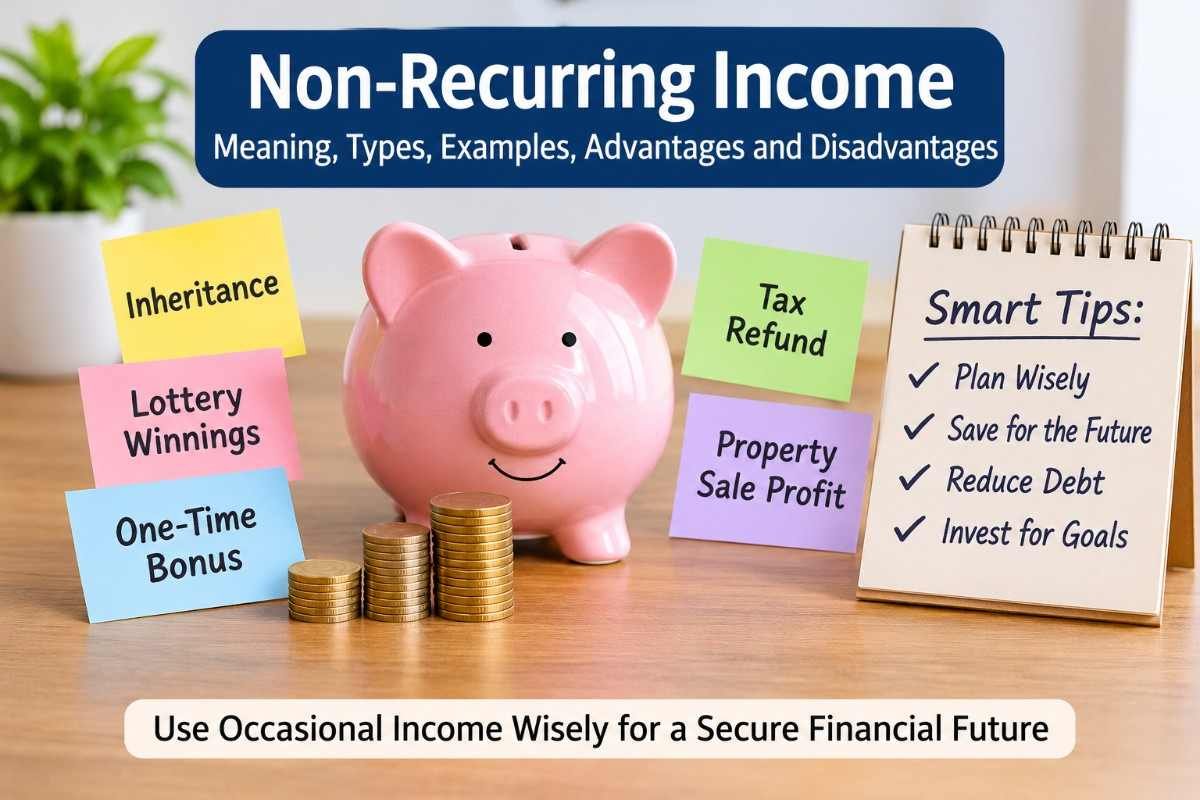
Non-recurring income refers to money received occasionally or from a one-time event rather than through a regular payment schedule. It can come from selling an old car, receiving an inheritance, winning a prize, getting a one-time bonus, or earning money from a special project.
Understanding non-recurring income helps individuals, students, entrepreneurs, and businesses make better financial decisions. It also teaches an important financial lesson: money received once should not always be treated as money that will continue coming in the future.
In this lesson, we will explore the meaning of non-recurring income, its types, real-life examples, advantages, disadvantages, and differences from recurring income.
What Is Non-Recurring Income?
Non-recurring income is money earned or received from an occasional, unusual, or one-time source that is not expected to continue regularly.
Unlike a monthly salary or regular business revenue, non-recurring income does not follow a predictable payment schedule.
For example, imagine a person who receives a monthly salary of $3,500. One month, they also receive a $2,000 prize from a competition. The salary is recurring income, while the prize money is non-recurring income.
Similarly, a business may receive regular revenue from selling products but also earn additional money by selling an old company building. The money from selling the building is generally considered a non-recurring gain rather than regular operating revenue.
The main characteristic of non-recurring income is that it is not a dependable source of regular future earnings.
How Does Non-Recurring Income Work?
Non-recurring income usually occurs when an individual or business receives money from an event that does not happen regularly.
For example:
- A person receives an inheritance from a family member.
- An employee receives a special one-time performance award.
- A freelancer earns money from a single project.
- A business sells an unused property and makes a profit.
- Someone wins a cash prize in a competition.
These payments can increase the amount of money available at a particular time. However, they should not automatically be considered part of a person’s regular monthly income.
For better financial planning, it is important to separate regular earnings from occasional financial gains.
15 Examples of Non-Recurring Income
Non-recurring income can come from several personal, professional, and business-related activities.
Here are 15 common examples:
- Inheritance Money: Money received from a deceased family member or another person through an inheritance.
- Lottery Winnings: Money received from winning a lottery or cash prize competition.
- One-Time Bonus: An occasional financial reward given by an employer outside the regular salary structure.
- Tax Refund: Money returned by the government when a taxpayer has paid more tax than required.
- Gift Money: A financial gift received from friends, family members, or other individuals.
- Property Sale Profit: Money earned by selling land, a house, or another property at a higher price than its purchase cost.
- Sale of Personal Assets: Money received from selling an old car, furniture, jewelry, electronics, or other personal belongings.
- Legal Settlement: Money received through a one-time legal settlement or compensation agreement.
- Insurance Payout: A lump-sum payment received after an eligible insured event.
- Competition Prize: Money awarded for winning a sports event, academic competition, or other contest.
- One-Time Freelance Project: Payment received for completing a project that does not involve an ongoing contract.
- Business Asset Sale: A company earns money by selling equipment, machinery, land, or other assets.
- Severance Payment: A one-time payment provided to an employee when employment ends under an eligible arrangement.
- Special Compensation: A one-time payment received for a particular achievement, event, or circumstance.
- Sale of Business Ownership: Money received from selling a business or a portion of ownership in a company.
Important: Not every large or occasional payment is automatically non-recurring income. Its classification depends on the nature of the transaction. For example, selling inventory is usually part of normal business operations, while selling an unused company building may generate a non-recurring gain.
Types of Non-Recurring Income
Non-recurring income can be divided into different categories depending on where the money comes from.
1. Personal Non-Recurring Income
Personal non-recurring income refers to occasional money received by an individual rather than through regular employment or business earnings.
Examples include inheritance, gifts, lottery winnings, tax refunds, and proceeds from selling personal belongings.
2. Employment-Related Non-Recurring Income
This category includes one-time payments received through employment.
Examples include special performance awards, severance payments, and certain one-time bonuses.
However, bonuses that are regularly paid under an established compensation arrangement may be better classified as recurring or variable income.
3. Investment-Related Non-Recurring Income
Investment-related non-recurring income may arise when an investor sells an asset and realizes a gain.
Examples include profits from selling property, shares, or other investments.
Regular interest or dividend payments are generally recurring income when received consistently.
4. Business Non-Recurring Income
Businesses can receive non-recurring gains from transactions outside their usual operations.
Examples include selling an unused building, disposing of a business division, or receiving a significant one-time settlement.
These gains are important when analyzing a company’s financial performance.
5. Compensation and Settlement Income
This category includes occasional payments received as compensation for a specific event or situation.
Examples include certain insurance proceeds, legal settlements, and eligible compensation payments.
The tax treatment of these payments depends on the applicable laws and the reason for receiving them.
Non-Recurring Income vs. Recurring Income
Recurring income and non-recurring income are two important financial concepts. Both increase the money available to an individual or business, but they differ in frequency and predictability.
| Basis | Recurring Income | Non-Recurring Income |
|---|---|---|
| Meaning | Money received regularly | Money received occasionally or once |
| Frequency | Weekly, monthly, or yearly | Irregular or one-time |
| Predictability | Generally more predictable | Less predictable |
| Stability | Usually provides ongoing cash flow | Does not guarantee future income |
| Financial Planning | Can support regular budgeting | Better treated as additional income |
| Examples | Salary, rent, regular interest | Inheritance, prize money, asset-sale gain |
| Future Expectations | Expected to continue | Not expected to continue regularly |
Example of Recurring Income
Suppose an employee earns $4,000 every month from their job.
Their yearly salary is:
$4,000 × 12 = $48,000
This is recurring income because the employee receives regular payments.
Example of Non-Recurring Income
Suppose the same employee receives an inheritance of $15,000 from a relative.
This amount is non-recurring income because it comes from a one-time event rather than regular employment.
The employee’s financial situation improves temporarily, but the inheritance does not guarantee additional income in the following months.
Non-Recurring Income in Personal Finance
Non-recurring income plays an important role in personal financial management.
People sometimes receive unexpected or occasional money that can help them achieve financial goals. However, spending all of it immediately may create problems later.
For example, a person who receives a $10,000 inheritance might use the money to pay off debt, increase emergency savings, invest for the future, or cover an important expense.
A sensible approach is to evaluate financial priorities before deciding how to use the money.
Here are some useful ways to manage non-recurring income:
- Build Emergency Savings: Set aside some money for unexpected expenses such as medical bills, home repairs, or job loss.
- Pay Off High-Interest Debt: Use part of the money to reduce expensive credit card balances or other high-interest debt.
- Invest for Long-Term Goals: Consider suitable investments based on your financial situation, time horizon, and risk tolerance.
- Save for Major Purchases: Keep money aside for education, housing, transportation, or other important goals.
- Avoid Unnecessary Spending: Do not increase your regular lifestyle expenses based on money that may never arrive again.
Non-Recurring Income in Business
Non-recurring income is also important in business and financial accounting.
A company may generate most of its income through regular activities such as selling products, providing services, or manufacturing goods.
However, it may occasionally receive money from unusual transactions.
For example, a manufacturing company earns $500,000 from its normal business activities during a financial year. During the same year, it sells an unused warehouse and records a gain of $100,000.
The $100,000 gain is different from its ordinary product sales. It is a non-recurring gain that should be considered separately when evaluating the company’s ongoing financial performance.
Investors and financial analysts examine these items because a large one-time gain can make a company’s reported profit appear stronger than its normal business performance.
A company that earns a large profit from selling property may not be able to repeat that gain every year.
Advantages of Non-Recurring Income
Non-recurring income can provide several financial benefits when managed carefully.
- Additional Financial Support: It provides extra money beyond regular earnings and can help cover important financial needs.
- Debt Reduction: One-time payments can be used to reduce outstanding loans, credit card balances, and other financial obligations.
- Increased Savings: Individuals can use occasional income to strengthen their savings and emergency funds.
- Investment Opportunities: It can provide additional capital for suitable long-term investment opportunities.
- Business Financial Flexibility: Companies may use gains from occasional transactions to support restructuring, debt reduction, or other financial priorities.
- Support During Emergencies: Unexpected financial gains can help individuals manage difficult situations without relying entirely on borrowing.
- Funding Major Goals: It can help pay for education, home improvements, transportation, or other significant expenses.
Disadvantages of Non-Recurring Income
Although non-recurring income can improve financial circumstances, it also has certain limitations.
- Lack of Regularity: It does not provide a dependable payment schedule, making it unsuitable as the foundation of regular monthly expenses.
- Uncertain Future Income: Individuals cannot always predict when another one-time payment will arrive.
- Overspending Risk: Receiving a large amount of money can encourage unnecessary purchases and poor financial decisions.
- Limited Financial Stability: Depending on occasional payments can create problems when regular income is insufficient.
- Tax Considerations: Some types of non-recurring income may be taxable, depending on the source and applicable tax laws.
- Misleading Business Performance: A large one-time gain may make a company’s financial results look stronger than its normal operating performance.
- Poor Long-Term Planning: Treating occasional money as guaranteed future income can lead to unrealistic budgets and financial commitments.
How to Calculate Non-Recurring Income
There is no complicated formula for identifying non-recurring income. In a simple personal finance example, you can calculate it by adding all qualifying one-time income received during a particular period.
Formula:
Non-Recurring Income = Sum of All One-Time Income Received During a Period
Example Calculation
Suppose a person receives the following occasional payments during one year:
| Source of Income | Amount |
|---|---|
| One-time bonus | $2,000 |
| Tax refund | $1,200 |
| Competition prize | $800 |
| Gift money | $1,000 |
| Total | $5,000 |
Therefore:
Non-Recurring Income = $2,000 + $1,200 + $800 + $1,000
Total Non-Recurring Income = $5,000
This means the person received $5,000 in non-recurring income during that year.
This is a simplified budgeting calculation, not a tax calculation. The amount received is not necessarily the same as taxable income or profit.
Is Non-Recurring Income Taxable?
Non-recurring income is not automatically tax-free. Its tax treatment depends on the type of payment, the country, and the applicable tax regulations.
For example, certain prizes, investment gains, employment bonuses, and property-sale profits may be taxable under specific circumstances.
However, some gifts, inheritances, insurance proceeds, and other payments may receive different tax treatment.
In the United States, the IRS provides guidance on different types of income, including prizes, awards, gifts, and investment-related income.
Individuals should check the relevant tax rules before assuming that a one-time payment is exempt from taxation.
How to Identify Non-Recurring Income
Identifying non-recurring income is useful for creating a realistic financial plan.
Here are a few questions that can help:
- Does the Payment Occur Regularly? If the money is received only occasionally or from a one-time event, it may be non-recurring income.
- Is It Connected to Normal Activities? Determine whether the payment comes from regular employment or business operations.
- Can You Expect It Again? Consider whether there is a reasonable expectation of receiving the same type of payment in the future.
- Is It a One-Time Transaction? Money received from selling an asset or winning a competition is generally linked to a specific event.
- Is It Part of a Regular Agreement? A payment that looks occasional may actually be part of a recurring contractual arrangement.
These questions help distinguish regular earnings from unusual or occasional financial gains.
Real-Life Example of Non-Recurring Income
Consider a freelance graphic designer named Alex.
Alex earns approximately $3,000 every month by working with regular clients. This amount represents recurring income because it comes from ongoing professional work.
One month, Alex receives an additional $1,500 for designing a logo for a client who does not have an ongoing contract.
The extra $1,500 comes from a one-time project and may be treated as non-recurring income for budgeting purposes.
Alex decides to use the additional money to pay off a credit card balance and increase emergency savings.
This example demonstrates how non-recurring income can improve someone’s financial position without becoming a permanent source of earnings.
FAQ’s
What Is Non-Recurring Income Also Known As?
Non-recurring income is also known as one-time income, occasional income, irregular income, or non-regular income because it is received infrequently rather than regularly.
Is a bonus considered non-recurring income?
A one-time special bonus may be non-recurring, while regularly scheduled bonuses may be considered recurring or variable income.
Is rental income recurring or non-recurring?
Rental income is generally recurring when payments are received regularly under an ongoing rental agreement.
Is inheritance a non-recurring income?
Yes, inheritance is generally considered a one-time financial receipt rather than regular income.
Can non-recurring income be considered passive income?
Not necessarily. One-time income describes payment frequency, while passive income describes how income is earned.
Why is non-recurring income important?
It helps individuals and businesses understand occasional financial gains and make better budgeting and financial planning decisions.
How should you manage non-recurring income?
You can use it to build emergency savings, repay debt, invest for the future, or achieve important financial goals.
Is capital gain considered non-recurring income?
A capital gain from selling an investment or property may be non-recurring, particularly when it results from an occasional transaction.
What is non-recurring income in accounting?
In accounting, it generally refers to income or gains arising from unusual or infrequent transactions outside a company’s normal operating activities.
Is a tax refund considered non-recurring income?
A tax refund is generally an occasional financial receipt, although it represents a return of previously paid taxes rather than newly earned income.
Can businesses earn non-recurring income?
Yes. Businesses may receive non-recurring gains from selling assets, receiving settlements, or completing unusual transactions.
Sources / References:
- Consumer Financial Protection Bureau (CFPB)
- Corporate Finance Institute – Non-Recurring Items
- OpenStax / Saylor – Financial Plans and Budgets
- Wall Street Prep – Non-Recurring Items: Definition and Examples
- Internal Revenue Service (IRS) – Tax Information
Disclaimer:
This article is intended for educational purposes only and should not be considered professional financial, accounting, or tax advice. Consult a qualified professional for guidance regarding your individual financial situation.
Also Read: