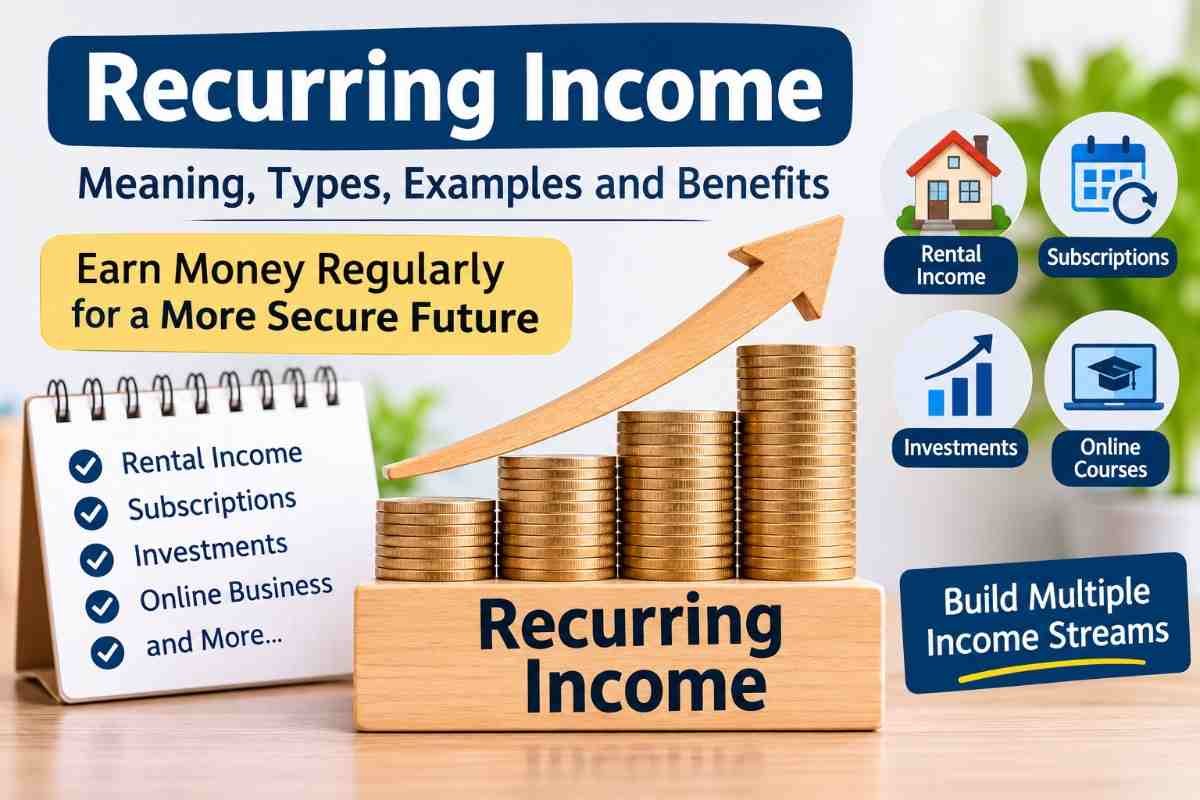
Recurring income is money a person or business receives regularly from the same source over a specific period, such as weekly, monthly, quarterly, or annually. It can come from rental properties, subscriptions, memberships, investments, online businesses, or other arrangements that generate repeated payments.
In today’s economy, recurring income has become an important financial concept for individuals, entrepreneurs, freelancers, and business owners. Instead of relying entirely on one-time payments, people look for ways to build income sources that provide more predictable cash flow over time.
For example, a person who receives $1,000 every month from a rental property has a recurring income source. Similarly, a software company that charges customers $20 per month for a subscription generates recurring revenue.
In this guide, we will explore the meaning of recurring income, its types, real-life examples, benefits, limitations, and how to build recurring income sources.
What Is Recurring Income?
Recurring income refers to money received repeatedly from an ongoing source rather than through a single transaction. These payments usually follow a regular schedule and may continue as long as an agreement, subscription, investment, or business relationship remains active.
The main idea behind recurring income is consistency. Instead of finding a new customer or completing a new transaction for every payment, an individual or business receives money from an existing source repeatedly.
Example:
Imagine you create an online educational course and charge students $15 per month to access it. If 100 students maintain their subscriptions, your monthly recurring revenue would be $1,500.
However, recurring income is not necessarily guaranteed. Customers may cancel subscriptions, tenants may move out, and investment distributions may change.
How Does Recurring Income Work?
Recurring income works through an arrangement that generates repeated payments over time. The arrangement may involve a customer, tenant, subscriber, investor, or business partner.
Here is a simple example:
- A business creates a product or service that customers need regularly.
- Customers agree to pay for continued access or service.
- Payments are collected according to a fixed schedule.
- The business continues providing the product or service.
- Revenue is generated again during the next billing period.
For example, a streaming platform charges customers a monthly subscription fee. Customers pay to continue watching content, and the company generates revenue as long as subscriptions remain active.
Some recurring income sources require ongoing work, while others may need less day-to-day involvement after they have been established.
15 Common Examples of Recurring Income
Recurring income can come from different activities, industries, and financial arrangements. Here are 15 practical examples:
- Rental Income: Property owners receive regular payments from tenants who rent their houses, apartments, or commercial spaces.
- Subscription Services: Businesses earn recurring payments by offering monthly or annual access to products, software, or digital services.
- Membership Fees: Gyms, clubs, and online communities collect regular membership payments.
- Dividend Income: Investors may receive dividend payments from companies that distribute a portion of their earnings to shareholders.
- Interest Income: Savings accounts, bonds, and other interest-bearing financial products may generate interest payments.
- Online Courses: Educators can offer subscription-based access to educational lessons, tutorials, and learning materials.
- Affiliate Income: Website owners may receive repeated commissions when referred customers make qualifying purchases or renew subscriptions.
- Retainer Payments: Freelancers and consultants may receive fixed monthly payments for providing ongoing professional services.
- Software Subscriptions: Software companies generate recurring revenue by charging customers monthly or annually.
- Licensing Income: Creators may receive repeated payments when others use their copyrighted work, designs, photographs, or intellectual property under licensing agreements.
- Maintenance Contracts: Service providers receive regular payments for ongoing maintenance, repairs, or technical support.
- Advertising Revenue: Websites and digital platforms may generate continuing advertising income when they consistently attract an audience.
- Franchise Royalties: Franchise owners may receive recurring royalty payments from franchise operators under contractual agreements.
- Equipment Leasing: Equipment owners earn regular payments by allowing businesses or individuals to use their machinery, tools, or other assets.
- Paid Newsletters: Publishers may charge readers monthly or annually for access to exclusive articles, research, and industry updates.
Types of Recurring Income
Recurring income can be divided into several categories depending on how the money is generated.
1. Active Recurring Income
Active recurring income is money earned through regular work or ongoing services. Although payments repeat, the person must continue providing time, effort, or professional skills.
Examples include:
- Monthly freelance writing contracts.
- Social media management services.
- Personal training memberships.
- Monthly consulting agreements.
- Website maintenance services.
2. Passive Recurring Income
Passive recurring income comes from assets, investments, or systems that can generate money without requiring constant direct involvement.
Examples include:
- Rental property income.
- Dividend payments.
- Royalties from books.
- Licensing fees.
- Interest from certain investments.
However, passive income is not always completely effortless. Property management, investment research, customer support, and maintenance may still require attention.
3. Business Recurring Income
Business Repeat income is generated when customers repeatedly pay a company for products, services, or continued access.
Examples include:
- Monthly software subscriptions.
- Annual memberships.
- Online learning subscriptions.
- Website hosting plans.
- Regular maintenance contracts.
4. Investment-Based Recurring Income
Investment-based Repeat income comes from financial assets that may provide periodic payments.
Examples include:
- Stock dividends.
- Bond interest.
- Interest-bearing savings accounts.
- Certain income-generating funds.
The amount and frequency of payments depend on the investment terms and performance. Some investments do not guarantee income.
How to Calculate Recurring Income?
Recurring income is calculated by adding the regular payments received from customers, tenants, subscribers, or other ongoing income sources during a specific period.
Formula:
Recurring Income = Number of Paying × Customers Average Payment
Example of Monthly Recurring Income
Suppose an online subscription business has 200 active customers, and each customer pays $15 per month.
| Description | Amount |
|---|---|
| Active customers | 200 |
| Monthly payment per customer | $15 |
| Monthly recurring income | $3,000 |
Calculation:
200 × $15 = $3,000 per month
Examples of Recurring Income Calculation
| Income Source | Monthly Income |
|---|---|
| Rental property | $1,200 |
| Online subscriptions | $800 |
| Freelance retainer | $500 |
| Investment distributions | $300 |
| Total recurring income | $2,800 |
How to Calculate Annual Recurring Income?
To estimate annual recurring income, multiply monthly recurring income by 12.
Formula:
Annual Recurring Income = Monthly Recurring Income × 12
For example:
$3,000 × 12 = $36,000 per year
Important: These calculations assume payments continue throughout the period. For actual income, account for cancellations, missed payments, vacancies, and changes in payment amounts. Also, recurring income represents revenue before expenses, not necessarily profit.
Recurring Income vs. One-Time Income
Recurring income and one-time income are two different ways of earning money. The main difference is how frequently payments are received.
| Basis | Recurring Income | One-Time Income |
|---|---|---|
| Meaning | Money received repeatedly | Money received once |
| Payment | Regular intervals | Single transaction |
| Predictability | Often more predictable | Depends on new sales or work |
| Customer relationship | Usually ongoing | Often temporary |
| Examples | Rent, subscriptions, retainers | Product sale, one-time project |
| Financial planning | Can support regular forecasting | May require more variable planning |
Example: A freelance designer who receives $500 for designing a single logo earns one-time income. However, if the same designer receives $500 every month for ongoing design services, that payment becomes Repeat income.
Recurring Income vs. Passive Income
Many people use recurring income and passive income interchangeably, but they have different meanings.
Repeat income describes how frequently money is received, whereas passive income describes the level of ongoing involvement required to generate that money.
| Basis | Recurring Income | Passive Income |
|---|---|---|
| Meaning | Income received repeatedly | Income generated with limited ongoing involvement |
| Work required | May require regular work | Usually requires less direct involvement |
| Payment frequency | Usually periodic | Can be regular or irregular |
| Examples | Monthly consulting fees, rent | Royalties, certain investment earnings |
| Main focus | Repeated payments | Income with limited active effort |
For example, a consultant who works with a company every month earns Repeat income, but it is not necessarily passive because the consultant must continue working.
On the other hand, an author may receive royalties from an existing book without personally working on every sale.
Benefits or Advantages of Recurring Income
Recurring income offers several potential advantages for individuals and businesses.
- More Predictable Cash Flow: Regular payments can make it easier to estimate how much money may come in each month.
- Better Financial Planning: Consistent income can help individuals and businesses plan budgets and expenses.
- Customer Relationships: Businesses can build long-term relationships with customers through subscriptions and ongoing services.
- Business Stability: Multiple reliable recurring income sources can reduce dependence on individual sales.
- Growth Opportunities: Businesses can reinvest some of their recurring revenue into marketing, technology, and product development.
- Time Management: Established systems and automated billing can reduce repetitive administrative tasks.
- Multiple Income Sources: Individuals can develop different income streams instead of depending entirely on one source.
- Long-Term Opportunities: Well-managed Repeat income arrangements can support financial goals over an extended period.
Disadvantages of Recurring Income
Although recurring income has many advantages, it also comes with certain challenges.
- Customer Cancellations: Subscribers or clients may cancel their agreements, reducing future income.
- Initial Investment: Some income sources require money, equipment, property, or significant time to establish.
- Ongoing Maintenance: Businesses must continue delivering value to keep customers interested.
- Market Competition: Similar products and services may attract customers away from an existing business.
- Uncertain Payments: Rental vacancies, investment losses, and missed payments can affect expected income.
- Customer Dependence: Relying heavily on a small number of customers can create financial risks.
- Operating Expenses: Repeat income does not mean recurring profit because businesses still have expenses.
- Changing Customer Needs: Products and services may need regular improvements to remain useful.
How to Build Recurring Income
Building recurring income usually requires selecting a suitable income source, creating something valuable, and developing a system that encourages repeated payments.
Here are some important steps:
1. Choose an Income Model
Start by deciding how you want to generate repeated income. You might consider offering a service, creating digital products, renting an asset, or investing in suitable financial products.
2. Identify a Specific Audience
Understand who may benefit from your product or service. Research their problems, interests, and willingness to pay for an ongoing solution.
3. Create Something Valuable
Your product or service should provide a clear reason for customers to continue paying. Examples include educational content, professional support, useful software, or convenient subscription deliveries.
4. Set a Payment Structure
Decide whether customers will pay weekly, monthly, quarterly, or annually. Make the pricing and payment conditions easy to understand.
5. Build a Reliable System
Use suitable tools to manage customer accounts, payment collection, subscriptions, renewals, and communication.
6. Maintain Customer Satisfaction
Repeat income depends heavily on retaining customers. Provide reliable service, respond to problems, and improve your offerings when necessary.
7. Monitor Income and Expenses
Track payments, cancellations, operating costs, and profits. This helps you understand whether your Repeat income model is financially sustainable.
Industries That Commonly Use Recurring Income Models
Recurring income is not limited to online businesses. It is used in many industries.
| Industry | Recurring Income Example |
|---|---|
| Technology | Software subscriptions |
| Education | Online learning memberships |
| Real Estate | Monthly rental payments |
| Healthcare | Subscription-based services |
| Fitness | Gym memberships |
| Entertainment | Streaming subscriptions |
| Finance | Interest and dividend payments |
| Marketing | Monthly advertising contracts |
| Publishing | Paid digital subscriptions |
| Transportation | Vehicle leasing |
Important Factors to Consider Before Building Recurring Income
Before choosing a Repeat income model, it is important to understand its financial and operational requirements.
- Initial Costs: Calculate how much money or time you need to start.
- Demand: Make sure people actually need the product or service.
- Profit Margins: Consider expenses before estimating potential earnings.
- Competition: Understand what similar businesses are offering.
- Customer Retention: Consider how you will encourage customers to continue using your service.
- Legal Requirements: Review applicable business regulations, consumer protection rules, contracts, and tax obligations.
- Risk Management: Avoid depending entirely on one income source.
- Long-Term Sustainability: Choose a model that can continue delivering value over time.
FAQ’s
Is recurring income the same as passive income?
No. Repeat income describes repeated payments, while passive income generally involves earning money with limited ongoing involvement.
Is rental income recurring income?
Yes. Rental income is generally recurring when tenants make regular payments under an ongoing rental agreement.
Can recurring income be earned online?
Yes. Online courses, paid newsletters, software subscriptions, memberships, and certain affiliate programs can generate Repeat income.
What is the difference between MRR and ARR?
MRR measures monthly recurring revenue, while ARR measures its annualized value over 12 months.
Is recurring income guaranteed?
No. Customers may cancel subscriptions, tenants may stop paying rent, and investment distributions may change.
What is a recurring revenue business model?
It is a business model in which customers make repeated payments for continued access to a product, service, membership, or other offering.
Can a freelancer earn recurring income?
Yes. Freelancers can earn Repeat income through monthly retainers, ongoing client contracts, and regular service agreements.
What is the opposite of recurring income?
One-time income is generally considered the opposite of Repeat income because it comes from a single transaction rather than repeated payments.
Why is recurring income important for businesses?
It can improve revenue predictability, support financial planning, strengthen customer relationships, and create opportunities for sustainable business growth.
What is another word for recurring income?
Another word for recurring income is regular income, repeat income, continuous income, or predictable income. In business, it is also commonly called recurring revenue.
What is recurring net income?
Recurring net income refers to the profit a business regularly earns from its ongoing operations after deducting operating expenses, taxes, interest, and other applicable costs. It generally excludes unusual or non-recurring gains and expenses.
Sources / References:
- Stripe – Recurring Revenue: Definition, Models, and How It Works.
- Salesforce – What Is Recurring Revenue?.
- Investor.gov – Corporate Bonds and Fixed Income Products.
- Investor.gov – Bonds FAQs.
- Corporate Finance Institute – Revenue Streams.
Disclaimer:
This article is for educational and informational purposes only. It does not constitute financial, investment, legal, or tax advice. Consult a qualified professional before making financial decisions.
Also Read: